Kids and Porn Online...It's Far Worse Than You Think
Almost 50% of Young People Between 10 and 17 Have Admitted to Being Exposed to Porn Online According to a Recent Report.
But our polls of thousands and thousands of young people show that 90% of these young people have been exposed to porn online, and the only reason the other 10% haven't is because they have parental controls still installed. Why the discrepancy? The report was conducted from a survey of young people after their parents were asked for their consent, and on the phone. How many young people would admit to porn exposures? It's amazing that as many admitted it as did.
by Parry Aftab, copyright 2007, all rights reserved
Parents need to realize that if their kids are online and unfiltered, most if not all have been exposed to porn.
I recently spoke at a school in Atlanta. It was a very elite private school, with bright and terrific students. I was doing a presentation to 4th graders. My presentations to students are very interactive with lots of questions and answers. I asked them how many had seen "bad stuff" online (which one of the students defined as "naked people"). Almost all of the hands went up.
The parents, standing in the back of the room, gasped and in some cases burst into tears. They were shocked that their 8 year olds had seen these kinds of things. They were devastated to learn that their children hadn't come to them for help. These were caring parents, relatively tech-savvy, well-educated and affluent. If they didn't know, what kind of a chance do less tech-savvy, less educated parents have?
Our kids, all our kids, will have been exposed to some pretty disgusting stuff. The Internet porn is not our parents' tame Playboy magazine. Our children are not prepared for this. Frankly, I don't know many adults who are. So, what do we do?
An Overview of the Porn Problem
Open your e-mail box or conduct a search for anything online and you are likely to run into graphic sexual images or content whether you like it or not. And our children are often more likely to be targeted by pornographic images or messages than we are, because of how they communicate online and how easy they are for the marketers to find.
Most Internet users are unhappy about the continued growth of marketing abuses and questionable advertising practices by many members of the pornography industry. What used to be just an annoyance and considered part of the price of using the Internet is now becoming a more serious problem. It is also becoming one that parents increasingly are insisting something be done to address.[1]
When anyone searches for information online, or mistypes or misspells a domain name (“typo-squatting”), they may find themselves at a pornography site.
When they open their e-mail boxes or instant messaging programs they may find themselves targeted by unscrupulous ads including those for “young teens,” “preteens” and “little girls or boys” sex (often mere fraudulent advertising), or sites promising child pornography and “lolitas.”
They seek images for school reports, using innocent topic names, such as "toys," "japanese dolls," and "american girl" only to encounter pornographic images. Many of these images show graphic sexual activities which can be frightening and hurtful to children and preteens, as well as many teens.
To compound the problem, when they stumble upon a pornography site, they may find themselves locked in an avalanche of new pornography windows, unable to escape without having to shut down their computers (“mousetrapping”).
And sometimes when they type in the URL of their favorite site, they end up at a pornography site instead, either because traffic for that site had been redirected by a pornography site (“hijacking”) or because the siteowner had forgotten to renew their domain name registration (“porn-napping”).
As competition among the pornography sites increases, these marketing abuses increase. Unintended exposure is a serious and growing problem. These marketing abuses and questionable practices currently include:
· Child pornography (real and virtual)
· Sexual exploitation of children (including false advertising of child pornography and use of terms implying child pornography, such as “preteens,” “little boys” and “lolitas”)
· SPAM/SPIM[2]
· Fraudulent headers in promotional e-mails
· Fraudulent or misleading metatags, keywords, descriptions and listings with search engines
· Typo-squatting[3], particularly those intended to attract children
· Misleading domain names or keywords, particularly those intended to attract children
· The use of terms to attract those seeking child pornography
· Intellectual property violations, piracy and counterfeiting
· Browser hijacking/ Mousetrapping
· Slammed home page changes
· Spyware and adware, pop-ups and pop-unders[4]
· Graphic images on the non-subscriber front pages
· Graphic images in unsolicited e-mail and instant messaging links
· Spoofing and phishing practices[5]
· Domain-napping/ Porn-napping[6]
· Criminal re-dialers and similar schemes[7]
· Page-jacking[8]
· Malicious code, criminal intrusions and Trojan horses
To quote so many parents, “something has to be done.” And while some of them may support an eventual total ban on all pornography and some others support an unrestricted right for adults to view pornography, all of them support an immediate solution to the issue of unintended exposure.
What is the solution? It actually has several components.
The first is education- of parents, teachers and the kids themselves. They need to understand how unscrupulous websites can target young people by "tricking them into clicking" and what technologies and tools exist to help block access to these sites and marketing tactics.
The second is creating laws that will fill any loopholes for unscrupulous marketing tactics, where the pornography sites pretend to be kid-friendly sites to draw Internet users of all ages to their site, using metatags, misleading domain names, typos, TLDs designed to confuse users (.com for a favorite .gov sites, for example whitehouse.com) etc.
The third is providing sufficient funding of law enforcement and prosecutorial groups to take on the bad guys and put those who are breaking the laws into jail where they belong.
The fourth is teaching everyone where to report sites they find are violating the law and where to find safe and fun sites for kids.
And fifth is reminding the adult sites that preying on kids is bad business and finding ways to identify those who have adopted responsible marketing and security practices.
Until then, surveys that demonstrate that only 42% of young people between 10 and 17 have been exposed to sexually explicit content online under-estimate the problem by 1/2.
If our kids are online and are not fully filtered, they have been exposed to porn. Sadly, because they are afraid of their parents' reactions, embarrassed and worried that they might have done something wrong, kids won't tell their parents.
So, once again, parents will be the last to know.
[1] The pornography marketing complaints received from parents and children themselves by WiredSafety.org and its family of sites has increased substantially over the last several months. From approximately 30 daily complaints from parents/grandparents and teachers about unintended exposure to online pornography, the number has increased to hundreds a day. Sixty-five percent of these same parents/grandparents have indicated that they either support an adult’s right to access legal pornography or recognize their legal right to do so. They have also, until now, been unhappy with (but haven’t lodged any formal complaints against) the onslaught of online marketing, misleading practices and sexually-graphic images they have encountered. They largely believed that nothing could be done to stop it. That has now changed. Now they are looking for ways to make it stop. More than mere technical tools, they want help, either from their ISPs or the government. They want someone to do something to help prevent their children from being confronted with pornography when searching for innocent sites, playing games and even using their computer in an “always on” environment, when pop-ups will appear on screen unexpectedly.
[2] “SPIM” is the new name for unsolicited bulk instant messages. “Spam” is the e-mail equivalent (no relation to Hormel’s luncheon meat).
[3] When someone, generally a pornographic website operator, registers the common misspellings of a popular site, especially one aimed at children.
[4]“The websites that attract children and teens in droves are the ones most often targeted by some in the porn industry via pesky pop-up ads… A pop-up is an advertisement that comes up when you first click onto a website… Designed to draw your attention to an aspect of the site you're visiting or to sell you a product or service, most are harmless. But as many parents have discovered a large number of pop-ups include offensive photos of sex acts not suitable for young eyes. To see these hardcore pop-ups you usually have to come across a porn site, says Cathy Wing, director of community programming for Media Awareness Network. `Once you stumble on a porn site or go to one purposely it will trigger these,’ she said from her office in Ottawa. Even worse is when sites aimed at teens _ skateboarding, music, video games _ trigger pop-ups with questionable content, Wing said. ‘Tons of these sites that teens like to go to will eventually lead them to porn. That's the problem,’ she said. ‘It's the kind of sites that kids go to that they target.’” The-Cyberfile, Bgt , BY ANGELA PACIENZA, 25 February 2004, The Canadian Press.
[5] Pretending to be another website, often to trick people into providing their financial information and creditcard details for criminal purposes.
[6] WiredKids.org’s teen site, WiredTeens.com was recently grabbed by a pornographic website operator. It previously pointed to the WiredTeens.org main site. WiredSafety’s executive director, cyberlawyer Parry Aftab, is contemplating bringing criminal charges unless the site is returned.
[7] “Modem Hijacking: The Commission has used its training and tools to stop some of the most egregious and technically sophisticated schemes seen on the Internet. For example, the FTC's lawsuit against Verity International, Ltd., was prompted by the influx of hundreds of complaints in the last week of September 2000 through the CRC and logged in Consumer Sentinel. Investigation showed that high charges on consumers' phone lines were being initiated by ‘dialer’ software downloaded from teaser adult web sites. Many line subscribers had no idea why they received bills for these charges. Others discovered that a minor in their household -- or another person who did not have the line subscriber's authorization – accessed the Web sites and downloaded the dialer software. The dialer program allowed users to access the ‘videotext’ adult content without any means of verifying that the user was the line subscriber, or was authorized by the line subscriber to incur charges on the line for such service. Once downloaded and executed, however, the program actually hijacked the consumer's computer modem by surreptitiously disconnecting the modem from the consumer's local Internet Service Provider, dialing a high-priced international long distance call to Madagascar, and reconnecting the consumer's modem to the Internet from some overseas location, opening at an adult web site. The line subscriber -- the consumer responsible for paying phone charges on the line -- then began incurring charges on his or her phone lines for the remote connection to the Internet at the rate of $3.99 per minute.” (Prepared Witness Testimony ,The Committee on Energy and Commerce, W.J. "Billy Tauzin" Chairman, On-line Fraud and Crime: Are Consumers Safe?" Subcommittee on Commerce, Trade, and Consumer Protection , May 23, 2001, Ms. Eileen Harrington, Associate Director of Marketing Practices Bureau of Competition Federal Trade Commission.)
[8] "Pagejacking" and "Mousetrapping": “Earlier, in FTC v. Carlos Pereira d/b/a atariz.com, the Commission attacked a world-wide, high-tech scheme that allegedly ‘pagejacked’ consumers and then ‘mousetrapped’ them at adult pornography sites. ‘Pagejacking’ is making exact copies of someone else's Web page, including the imbedded text that informs search engines about the subject matter of the site. The defendants allegedly made unauthorized copies of 25 million pages from other Web sites, including those of Paine Webber and the Harvard Law Review. The defendants made one change on each copied page that was hidden from view: they inserted a command to ‘redirect’ any surfer coming to the site to another Web site that contained sexually-explicit, adult-oriented material. Internet surfers searching for subjects as innocuous as ‘Oklahoma tornadoes’ or ‘child car seats’ would type those terms into a search engine and the search results would list a variety of related sites, including the bogus, copycat site of the defendants. Surfers assumed from the listings that the defendants' sites contained the information they were seeking and clicked on the listing. The "redirect" command imbedded in the copycat site immediately rerouted the consumer to an adult site hosted by the defendants. Once there, defendants ‘mousetrapped’ consumers by incapacitating their Internet browser's ‘back’ and ‘close’ buttons, so that while they were trying to exit the defendants' site, they were sent to additional adult sites in an unavoidable, seemingly endless loop.” (Id.)
Monday, February 05, 2007


Kids being exposed to porn online
Today a new study was released, discussing how often kids are exposed to pornography online. While I deeply respect the researchers in this study, you will note that the kids were asked if they had been exposed to porn after their parents were asked for their consent. They were also asked on the phone.
In my own studies, almost 100% of the kids ten and over have been exposed to porn online. they just don't tell their parents becasue they are either embarassed or frightened of their reaction.
so how many kids are exposed to unwanted porn online? all of them.
Parry
In my own studies, almost 100% of the kids ten and over have been exposed to porn online. they just don't tell their parents becasue they are either embarassed or frightened of their reaction.
so how many kids are exposed to unwanted porn online? all of them.
Parry
Thursday, February 01, 2007
Beware of the most common cyber crime - cyber stalking « My Writings
Beware of the most common cyber crime - cyber stalking « My Writings
This is a great blog posting about cyberstalking in India. Thought I would share it with you.
This is a great blog posting about cyberstalking in India. Thought I would share it with you.
Wednesday, January 31, 2007
The New Age Examiner - Moms check out 'toxic' Internet
The New Age Examiner - Moms check out 'toxic' Internet
Local groups are setting up programs for thedir community on online safety.
Local groups are setting up programs for thedir community on online safety.
thedesertsun.com | Online predators target of bill
thedesertsun.com Online predators target of billOnline predators target of billMySpace, Congress team to keep sites free of sex offenders
Taya Lynn Gray, The Desert SunKatilyn Corl, of Cathedral City has her profile posted on the popular MySpace.com site on the internet. Her father, Rick Corl, has strict rules for his daughter when she uses MySpace to keep her safe.
TIPS FOR PARENTS
Tell kids not to share such personal information as names, addresses and the school they attend.
Review your child’s profile often for inappropriate messages or images.
You can find your child’s profile on MySpace by clicking on the "search" mode and entering your child’s name, e-mail address or school.
Parents can have a child’s profile removed by contacting MySpace’s parental help staff, www.WiredSafety.org or www.WiredKids.org.
Parents can install software that can record what kids say and post online. WiredSafety.org recommends programs such as those made by Spectorsoft, which can be found at www.software4parents.com or www.spectorsoft.com.
more online
January 31, 2007
January 31, 2007
WASHINGTON - In this technology savvy world, requiring sex offenders to register just their physical address is just not good enough, several members of Congress said Tuesday.
The lawmakers joined with MySpace.com in unveiling bipartisan legislation that would require sex offenders to also register their online identity - e-mail addresses and instant message user names - with federal officials.
"We have to plug the online loophole. Sex offenders have no business joining social networking communities, especially those popular among teens," said Sen. Chuck Schumer, D-N.Y., who is sponsoring the bill in the Senate with Sen. John McCain, R-Ariz.
The Justice Department would make the e-mail addresses of sex offenders available to social networking sites, upon request, so they could compare the data with their user profiles. Failure to register new e-mail addresses or IM names would result in fines and/or up to 10 years in prison, under the proposed legislation.
The bill also would make it illegal for someone to misrepresent his or her age on a social networking profile for the purposes of engaging in sexual activity with a minor.
"Our kids are pretty astute when it comes to cruising around on the Internet and it can be very scary," said Rep. Steve Chabot, R-Ohio, who is co-sponsoring the bill in the House with Reps. Earl Pomeroy, D-N.D., Anthony Weiner, D-N.Y., and Paul Gillmor, R-Ohio.
"It's long overdue that we pass this kind of legislation," Chabot said.
MySpace, one of a growing number of popular social networking Web sites, boasts 150 million registered users of which 21 million are children under age 18. Other social networking sites include Friendster.com, Facebook.com and Classmates.com.
User safety tipsThe Web site, increasingly concerned about stories related to the site’s safety, has numerous tips on how to safely navigate it. MySpace executives have teamed with WiredSafety.org to offer these tips:MySpace limits the use to users who are at least 14 years old. But the site has no way of knowing when users lie and give wrong ages.The pages of those under 16 cannot be accessed by persons they do not know or have accepted as friends.Inappropriate images, including those of nudity, are not allowed on the site. Violators have their accounts closed.Never publicly post any personally identifiable information that could be used to find or identify you in real life.What should never be posted: Your real name, address, telephone number, cell number, sports team, health club, or links to Web sites or other profiles that might give this information away.Why this is important: Identify theft. Information can be misused to steal your identity, guess your passwords, cyberstalk or harass you or by predators who really want to hurt you.Don’t reply to spam. At best, they go into a black hole and never get to the sender. At worst, you find yourself now on many more lists because they figured out you read the junk e-mail.Always use a disposable free e-mail address, like yahoo, hotmail or msn. If you run into problems, you can just stop using it and no one can follow you back to your real address - assuming you followed the tips about not sharing too much personal info.Being online does not make you completely anonymous. There are ways that people can discover real life information about the people they meet online.Some hacking programs and Spyware can grab your passwords and credit card information. Use a firewall and anti-virus program and update them automatically. Visit WiredSafety.org or the FTC.gov site for more information.Keep your password a secret. Sharing it can cause huge problems. And don’t use one that’s easy for someone to guess.Have a secret code word with your real life friends that you chat with online. If you are chatting with someone you think you know, but are suspicious if the person on the other side is really them or not, ask them for the password.ThinkB4UClick: Never reply to any attempt to gain personal or banking information from an e-mail that you did not originate.Fake MySpace Logins. It’s possible that someone could redirect you to a page that looks like a MySpace Login page, but really isn’t. When logging into MySpace, always check the URL bar at the top of your browser and make sure you see the MySpace.com domain in the first part of the URL.Treat others with respect, and expect the same from them. Don’t be obnoxious. Online arguments are known as "flaming." These incidents can escalate into off-line harassment. Do not harass others online. If you do it, can get your service revoked.If you ever feel like you’re in real danger from someone online, tell someone you trust and then go directly to your local law enforcement agency. Don’t delete the message. Also, a printout won’t be enough. The police will need the live communication to check out the headers and other coding to trace the sender or poster.Source: MySpace safety tips prepared in collaboration with WiredSafety.org
Taya Lynn Gray, The Desert SunKatilyn Corl, of Cathedral City has her profile posted on the popular MySpace.com site on the internet. Her father, Rick Corl, has strict rules for his daughter when she uses MySpace to keep her safe.
TIPS FOR PARENTS
Tell kids not to share such personal information as names, addresses and the school they attend.
Review your child’s profile often for inappropriate messages or images.
You can find your child’s profile on MySpace by clicking on the "search" mode and entering your child’s name, e-mail address or school.
Parents can have a child’s profile removed by contacting MySpace’s parental help staff, www.WiredSafety.org or www.WiredKids.org.
Parents can install software that can record what kids say and post online. WiredSafety.org recommends programs such as those made by Spectorsoft, which can be found at www.software4parents.com or www.spectorsoft.com.
more online
January 31, 2007
January 31, 2007
WASHINGTON - In this technology savvy world, requiring sex offenders to register just their physical address is just not good enough, several members of Congress said Tuesday.
The lawmakers joined with MySpace.com in unveiling bipartisan legislation that would require sex offenders to also register their online identity - e-mail addresses and instant message user names - with federal officials.
"We have to plug the online loophole. Sex offenders have no business joining social networking communities, especially those popular among teens," said Sen. Chuck Schumer, D-N.Y., who is sponsoring the bill in the Senate with Sen. John McCain, R-Ariz.
The Justice Department would make the e-mail addresses of sex offenders available to social networking sites, upon request, so they could compare the data with their user profiles. Failure to register new e-mail addresses or IM names would result in fines and/or up to 10 years in prison, under the proposed legislation.
The bill also would make it illegal for someone to misrepresent his or her age on a social networking profile for the purposes of engaging in sexual activity with a minor.
"Our kids are pretty astute when it comes to cruising around on the Internet and it can be very scary," said Rep. Steve Chabot, R-Ohio, who is co-sponsoring the bill in the House with Reps. Earl Pomeroy, D-N.D., Anthony Weiner, D-N.Y., and Paul Gillmor, R-Ohio.
"It's long overdue that we pass this kind of legislation," Chabot said.
MySpace, one of a growing number of popular social networking Web sites, boasts 150 million registered users of which 21 million are children under age 18. Other social networking sites include Friendster.com, Facebook.com and Classmates.com.
User safety tipsThe Web site, increasingly concerned about stories related to the site’s safety, has numerous tips on how to safely navigate it. MySpace executives have teamed with WiredSafety.org to offer these tips:MySpace limits the use to users who are at least 14 years old. But the site has no way of knowing when users lie and give wrong ages.The pages of those under 16 cannot be accessed by persons they do not know or have accepted as friends.Inappropriate images, including those of nudity, are not allowed on the site. Violators have their accounts closed.Never publicly post any personally identifiable information that could be used to find or identify you in real life.What should never be posted: Your real name, address, telephone number, cell number, sports team, health club, or links to Web sites or other profiles that might give this information away.Why this is important: Identify theft. Information can be misused to steal your identity, guess your passwords, cyberstalk or harass you or by predators who really want to hurt you.Don’t reply to spam. At best, they go into a black hole and never get to the sender. At worst, you find yourself now on many more lists because they figured out you read the junk e-mail.Always use a disposable free e-mail address, like yahoo, hotmail or msn. If you run into problems, you can just stop using it and no one can follow you back to your real address - assuming you followed the tips about not sharing too much personal info.Being online does not make you completely anonymous. There are ways that people can discover real life information about the people they meet online.Some hacking programs and Spyware can grab your passwords and credit card information. Use a firewall and anti-virus program and update them automatically. Visit WiredSafety.org or the FTC.gov site for more information.Keep your password a secret. Sharing it can cause huge problems. And don’t use one that’s easy for someone to guess.Have a secret code word with your real life friends that you chat with online. If you are chatting with someone you think you know, but are suspicious if the person on the other side is really them or not, ask them for the password.ThinkB4UClick: Never reply to any attempt to gain personal or banking information from an e-mail that you did not originate.Fake MySpace Logins. It’s possible that someone could redirect you to a page that looks like a MySpace Login page, but really isn’t. When logging into MySpace, always check the URL bar at the top of your browser and make sure you see the MySpace.com domain in the first part of the URL.Treat others with respect, and expect the same from them. Don’t be obnoxious. Online arguments are known as "flaming." These incidents can escalate into off-line harassment. Do not harass others online. If you do it, can get your service revoked.If you ever feel like you’re in real danger from someone online, tell someone you trust and then go directly to your local law enforcement agency. Don’t delete the message. Also, a printout won’t be enough. The police will need the live communication to check out the headers and other coding to trace the sender or poster.Source: MySpace safety tips prepared in collaboration with WiredSafety.org
Tuesday, January 30, 2007
16 year old charged in videotaping attack of another student
Long Island
Teen who taped North Babylon fight is chargedBY ZACHARY R. DOWDYNewsday Staff WriterJanuary 29, 2007, 10:17 PM EST
The North Babylon teenager who Suffolk police said videotaped the attack by three girls on a 13-year-old girl -- a four-minute film that was posted on the Internet and became a worldwide symbol of cyberbullying -- was arrested Monday after turning himself in.Police charged Bryan Alomar, 16, of North Babylon, with unlawful assembly, a Class B misdemeanor.
Alomar was released on $100 stationhouse bail and is due in First District Court in Central Islip on March 22."He was there and videotaped the whole thing," said Lt. Robert Edwards, commander of the First Precinct's Crime Section. "We're not sure who posted it on the Internet, but he was the recorder."The arrest is the latest development in a case that received worldwide media attention because the attack was boldly posted on the Internet.That deed, many observers said, was an act of information age-bullying because it further humiliated the victim in the attack by displaying the beating to the world."I sincerely hope that the message is getting out to young people all around the county and the country that bullying or physically abusing peers is serious and unacceptable, not entertainment fodder for a Web site," said Suffolk County Executive Steve Levy, reacting to the arrest.The video in question features three girls attacking another girl with considerable anger, knocking her down and, at times, pulling her hair and kicking her repeatedly in the head.Her father appeared on a national news show and said his daughter had expected to meet and talk with one girl, but that she was ambushed by three. The father said his daughter was able to cover up her hurt places and that he and his wife were not aware of the attack at the time.The attack was Dec. 18 outside Woods Road Elementary School in North Babylon.The three girls, all first-year students at North Babylon High School, were arrested earlier this month and charged with juvenile delinquency with an underlying charge of third-degree assault. They have been released to their parents' custody and have been suspended from school.The fight, investigators have said, stemmed from a dispute over a boy. The victim and one of the girls seen attacking her had both dated the same boy, police have said.The video that documents the attack was posted on several Web sites, including YouTube.com and MySpace.com, prompting school officials to alert police and discipline the teenagers.It was unclear Monday whether the boy over whom the girls were said to be fighting would also face charges. He was believed to have been present during the fight, too."Not as of now," Edwards said Monday of any charges against the boyfriend.Alomar also was suspended for five days from North Babylon High. Neither his parents nor his attorney could be reached for comment Monday night.
Teen who taped North Babylon fight is chargedBY ZACHARY R. DOWDYNewsday Staff WriterJanuary 29, 2007, 10:17 PM EST
The North Babylon teenager who Suffolk police said videotaped the attack by three girls on a 13-year-old girl -- a four-minute film that was posted on the Internet and became a worldwide symbol of cyberbullying -- was arrested Monday after turning himself in.Police charged Bryan Alomar, 16, of North Babylon, with unlawful assembly, a Class B misdemeanor.
Alomar was released on $100 stationhouse bail and is due in First District Court in Central Islip on March 22."He was there and videotaped the whole thing," said Lt. Robert Edwards, commander of the First Precinct's Crime Section. "We're not sure who posted it on the Internet, but he was the recorder."The arrest is the latest development in a case that received worldwide media attention because the attack was boldly posted on the Internet.That deed, many observers said, was an act of information age-bullying because it further humiliated the victim in the attack by displaying the beating to the world."I sincerely hope that the message is getting out to young people all around the county and the country that bullying or physically abusing peers is serious and unacceptable, not entertainment fodder for a Web site," said Suffolk County Executive Steve Levy, reacting to the arrest.The video in question features three girls attacking another girl with considerable anger, knocking her down and, at times, pulling her hair and kicking her repeatedly in the head.Her father appeared on a national news show and said his daughter had expected to meet and talk with one girl, but that she was ambushed by three. The father said his daughter was able to cover up her hurt places and that he and his wife were not aware of the attack at the time.The attack was Dec. 18 outside Woods Road Elementary School in North Babylon.The three girls, all first-year students at North Babylon High School, were arrested earlier this month and charged with juvenile delinquency with an underlying charge of third-degree assault. They have been released to their parents' custody and have been suspended from school.The fight, investigators have said, stemmed from a dispute over a boy. The victim and one of the girls seen attacking her had both dated the same boy, police have said.The video that documents the attack was posted on several Web sites, including YouTube.com and MySpace.com, prompting school officials to alert police and discipline the teenagers.It was unclear Monday whether the boy over whom the girls were said to be fighting would also face charges. He was believed to have been present during the fight, too."Not as of now," Edwards said Monday of any charges against the boyfriend.Alomar also was suspended for five days from North Babylon High. Neither his parents nor his attorney could be reached for comment Monday night.
Monday, January 29, 2007
Wired News: MySpace Predator Caught by Code
Wired News: MySpace Predator Caught by Code
the wired news report on how they found registered sex offenders on myspace.
the wired news report on how they found registered sex offenders on myspace.
MySpace announces donation of sexual predator database to National Center for Missing and Exploited Children
CHILD PROTECTION DATABASE -- MySpace.com and SentinelTech will announce today that they are donating their Sentinel Safedatabase technology to the National Center for Missing & ExploitedChildren. (NCMEC). Sentinel Safe is a new database developed byMySpace and Sentinel Tech that enables Web sites and other thirdparties to effectively identify, remove, and block convicted sexoffenders from online communities.
While I am happy to see any technology that helps protect kids from sexual exploitation being used to its fullest capacity, I still don't see how this will have a serious impact on child's safety. How many registered sex offenders will continue to use their real names and pictures (that can be paired with mugshots) on myspace?
Wired ran a great story on this months ago. The journalist worked for months on pairing registered sex offenders (not just of kids, though) with members on myspace. He had many false positives. For example every "Ned Smith" profile may not be the same "Ned Smith" who is a sex offender. But he found about 700 who apparently matched up.
Several other media outlets followed this lead and ran the same search for their locale. Lots of registered sex offenders were outted on myspace and other sites. So did many law enforcement agencies.
But each of these searches had to be done laboriously and manually. Matching up sex offender registries with zipcodes and names, one by one.
MySpace has been trying to help protect their users (really) for two years now. They started by asking WiredSafety for guidance in early 2005. Our safety tips resided there for more than a year. Later, they joined forces with NCMEC and other groups as well. This software announcement is a repeat of an announcement made months ago about the alliance between MySpace and Sentinel. The software allows an easy pairing of the registry databases with the registration info at myspace. That will help identify the sex offenders who are stupid enough to continue to use their real names and locations and pictures on myspace.
(Actually, even if they take those down, the search descriptions on myspace continue to list the information after the changes are made on the profile itself. We have spotted this as a problem with teens who have now set their profiles to "private" while the descriptions continue to share too much info. So, the sex offenders (happily) might get caught even after they make changes.)
The Virginia Attorney General has proposed adding a requirement that registered sex offenders be required to share their e-mail addresses with the authorities. This can have a big impact. Not, as many think, because the sex offenders will disclose their addresses, but more (IMHO) because when they don't, their parole/probation terms will be violated and they can go back to jail.
That I support!
I just don't see how donating this technology is newsworthy. But perhaps, every little bit helps when kids and predators are involved.
While I am happy to see any technology that helps protect kids from sexual exploitation being used to its fullest capacity, I still don't see how this will have a serious impact on child's safety. How many registered sex offenders will continue to use their real names and pictures (that can be paired with mugshots) on myspace?
Wired ran a great story on this months ago. The journalist worked for months on pairing registered sex offenders (not just of kids, though) with members on myspace. He had many false positives. For example every "Ned Smith" profile may not be the same "Ned Smith" who is a sex offender. But he found about 700 who apparently matched up.
Several other media outlets followed this lead and ran the same search for their locale. Lots of registered sex offenders were outted on myspace and other sites. So did many law enforcement agencies.
But each of these searches had to be done laboriously and manually. Matching up sex offender registries with zipcodes and names, one by one.
MySpace has been trying to help protect their users (really) for two years now. They started by asking WiredSafety for guidance in early 2005. Our safety tips resided there for more than a year. Later, they joined forces with NCMEC and other groups as well. This software announcement is a repeat of an announcement made months ago about the alliance between MySpace and Sentinel. The software allows an easy pairing of the registry databases with the registration info at myspace. That will help identify the sex offenders who are stupid enough to continue to use their real names and locations and pictures on myspace.
(Actually, even if they take those down, the search descriptions on myspace continue to list the information after the changes are made on the profile itself. We have spotted this as a problem with teens who have now set their profiles to "private" while the descriptions continue to share too much info. So, the sex offenders (happily) might get caught even after they make changes.)
The Virginia Attorney General has proposed adding a requirement that registered sex offenders be required to share their e-mail addresses with the authorities. This can have a big impact. Not, as many think, because the sex offenders will disclose their addresses, but more (IMHO) because when they don't, their parole/probation terms will be violated and they can go back to jail.
That I support!
I just don't see how donating this technology is newsworthy. But perhaps, every little bit helps when kids and predators are involved.
The Internet brings out the best and the worst in people
I've been doing this a very long time. I have protected kids, adults and celebrities online. I have worked with everyone in the industry to help create a safer and more responsible Net.
I started fighting this fight in 1997. Before then I protected corporations in cyberspace. (moving form protecting corporations at hefty hourly legal rates, to working for free to protect kids wasn't necessarily a great business move. :-))
While I understand how kids and young teens may act out online, and do things they shouldn't, I am always amazed at the outrageous things adults will do online.
Cyberbashing....something short of cyberstalking, akin to cyberharassment, is something businesses do to their competitors and people with way too much time on their hands do online to bother others.
I wish we had a law against rudeness and immaturity online. It's such a waste of time and bandwidth.
my 2 cents.
I started fighting this fight in 1997. Before then I protected corporations in cyberspace. (moving form protecting corporations at hefty hourly legal rates, to working for free to protect kids wasn't necessarily a great business move. :-))
While I understand how kids and young teens may act out online, and do things they shouldn't, I am always amazed at the outrageous things adults will do online.
Cyberbashing....something short of cyberstalking, akin to cyberharassment, is something businesses do to their competitors and people with way too much time on their hands do online to bother others.
I wish we had a law against rudeness and immaturity online. It's such a waste of time and bandwidth.
my 2 cents.
Sunday, January 28, 2007
Putting Your Best Foot Forward

We're seeing more and more prospective employers deciding not to hire teens and college students because of what they have posted online....
it's time to teach our kids to put their best foot forward online, just as they would in public offline.
what they post online counts!
I always say that what you post online stays online...forever!
Friday, January 26, 2007
Hattiesburg American - www.hattiesburgamerican.com - Hattiesburg, Miss.
Not sure that all points, especially about facebook, are accurate, but here's a recent article.Hattiesburg American - www.hattiesburgamerican.com - Hattiesburg, Miss.
Thursday, January 25, 2007
CJOnline Blogs - Why teens risk online exposure, and how parents can help
Myspace safety? it's more than just safety tips....CJOnline Blogs - Why teens risk online exposure, and how parents can help
Unlike Vegas, what happens online goes all over
think twice before doing anything online that you don't want a future employer to read...Unlike Vegas, what happens online goes all over
violent videos online
Jan 20, 2007 4:27 pm US/Central
Violent Videos Come Under Fire On The Web
Frank Vascellaro
Reporting
(WCCO) This week, Web sites like YouTube and MySpace came under attack for hosting violent videos like the video of three 9th grade girls from Long Island taking turns pulling hair, punching and even stomping on an 8th grade girl.
The attack was taped and posted on the web and safety experts say many parents have no idea videos like that even exist out in cyberspace.
Playground fights are nothing new, but posting them on video websites is.
The parents of one 13-year old beating victim did not want to press charges until it ended up on the Internet.
"By putting these images up on the Internet, you get attention. You get fame. It's a culture in which kids are looking to be famous," said psychologist James Garbarino.
Police and other law enforcement agencies have started monitoring popular websites for violent videos. Once the clips are out in the open it can become the perfect evidence because the act of posting it becomes an admission of guilt.
"They don't say, 'I'm putting on a picture of a fight which is against the law.' It's, 'I'm putting on a picture of a fight. I will have 15 minutes of fame.' They don't see it as a criminal act," said Roni Benson an anti-bullying advocate.
Even if your kids never get involved in any violence, experts worry about another risk. Parry Aftab with wiredsafety.org says the videos make gang life seem exciting and cool to lure kids in.
"It's allowing gangs to recruit beyond where they used to. So, we have a lot of kids who are bored in upper middle class suburban neighborhoods who are now finding that it might be kind of fun to hang out with the Bloods," said Aftab.
YouTube said it pulls any flagged video that shows someone being "hurt, attacked or humiliated."
MySpace said it removes flagged videos with "offensive content, hate speech and violence."
Policies aside, the videos are posted and advocates are concerned that most parents have no idea and need to be warned.
"What we need to let parents know is your kids can stumble on it. You have to talk to them ahead of time about what they may find," said Aftab.
In recent weeks, the video Web sites have added safety teams that also monitor and remove inappropriate content as it's discovered.
(© MMVII, CBS Broadcasting Inc. All Rights Reserved.)
Violent Videos Come Under Fire On The Web
Frank Vascellaro
Reporting
(WCCO) This week, Web sites like YouTube and MySpace came under attack for hosting violent videos like the video of three 9th grade girls from Long Island taking turns pulling hair, punching and even stomping on an 8th grade girl.
The attack was taped and posted on the web and safety experts say many parents have no idea videos like that even exist out in cyberspace.
Playground fights are nothing new, but posting them on video websites is.
The parents of one 13-year old beating victim did not want to press charges until it ended up on the Internet.
"By putting these images up on the Internet, you get attention. You get fame. It's a culture in which kids are looking to be famous," said psychologist James Garbarino.
Police and other law enforcement agencies have started monitoring popular websites for violent videos. Once the clips are out in the open it can become the perfect evidence because the act of posting it becomes an admission of guilt.
"They don't say, 'I'm putting on a picture of a fight which is against the law.' It's, 'I'm putting on a picture of a fight. I will have 15 minutes of fame.' They don't see it as a criminal act," said Roni Benson an anti-bullying advocate.
Even if your kids never get involved in any violence, experts worry about another risk. Parry Aftab with wiredsafety.org says the videos make gang life seem exciting and cool to lure kids in.
"It's allowing gangs to recruit beyond where they used to. So, we have a lot of kids who are bored in upper middle class suburban neighborhoods who are now finding that it might be kind of fun to hang out with the Bloods," said Aftab.
YouTube said it pulls any flagged video that shows someone being "hurt, attacked or humiliated."
MySpace said it removes flagged videos with "offensive content, hate speech and violence."
Policies aside, the videos are posted and advocates are concerned that most parents have no idea and need to be warned.
"What we need to let parents know is your kids can stumble on it. You have to talk to them ahead of time about what they may find," said Aftab.
In recent weeks, the video Web sites have added safety teams that also monitor and remove inappropriate content as it's discovered.
(© MMVII, CBS Broadcasting Inc. All Rights Reserved.)
Wednesday, January 24, 2007
Cyberbullies face few consequences
I would like to beef up legal protections...but I disagree with the journalist here. I think there are more laws in the legal arsenal that work here. Cyberbullies face few consequences
Lawsuits Against MySpace.com Mounting - News
new lawsuits by families of cyber sexual predator victims plague myspace. Lawsuits Against MySpace.com Mounting - News
Tuesday, January 23, 2007
The realities of myspace and teens online - keeping them safer on myspace
Why teens risk online exposure, and how parents can help
Posted by
Daily Dose - News in News2 Topeka Kansas, January 12, 2007
Kevin smokes pot and drinks alcohol on a monthly basis. Damisha, who never has kissed more than one person in the same day, thinks Jazmyne flirts more than anyone she knows. Laci works at a day care and has no idea what she wants to do with her life, but she would like to get engaged before the year ends.
Kevin, Damisha and Laci, who identify themselves as teenagers living in Topeka, posted this information to their Myspace Web pages.
And there are many others who have much more to say. As teens look online to develop social connections, they often divulge too much information, putting themselves at risk with parents, employers, police and predators.
“It’s the future of the Net,” said Parry Aftab, a privacy lawyer and executive director of wiredsafety.org, an online resource for teaching teens and parents the dos and don’ts of social networking.
Because it’s the future, she said, we have a responsibility to embrace the technology and use it wisely — even if you’re not comfortable with it.
Last month, local parents expressed outrage following a story in the Topeka West student newspaper that included blurred images posted to Myspace. The photos showed teens drinking.
Ron Harbaugh, spokesman for Topeka Unified School District 501, said 501 schools provide students with information about the dangers of social networking. Sites like Myspace, he said, are blocked on school computers.
But what students do at home is up to them, he said.
“They’re aware of the dangers, especially after recent incidents, but that’s their decision,” Harbaugh said.
That’s the wrong approach, according to Aftab. Teens are told about risks by parents, friends, teachers and media, but they aren’t listening, she said.
“They can tell you the words, but they don’t believe it,” Aftab said. “They think it can be risky, but only for stupid kids. They think it can be a problem, but only for kids who don’t get it. Not them. It doesn’t apply to them.”
Aftab — who says she talks to thousands of teens and parents on a monthly basis — described an exercise in which she asks students to raise their hands if they feel safe online. Invariably, they all raise their hands. Then she asks them to raise their hands if they think their friends are safe online. No students raise their hands.
This indicates that teens understand that bad things can happen. They just aren’t realistic about their own vulnerability, she said.
To get through to teens, Aftab uses several tactics.
First, she tells them to have what she calls “a wired buddy,” someone you trust to talk to about the content you’re putting online. Friends are more protective than we are of ourselves, Aftab said.
She also suggests teens protect their Web pages with passwords. If they feel the need to give out an e-mail address, they should set up a secondary one through a service like Hotmail.
Most important, she said, is to tell kids to think before they click.
“Don’t post anything that you think might embarrass you in a few years,” Aftab said. “Don’t post when you’re out at a slumber party and you’re goofing around. Don’t post when you’re at a frat party and you’re drunk. What you put online stays on forever.”
In addition to getting through to teens, though, Aftab said someone needs to get through to parents. Instead of being outraged, they should make sure their kids “know how to use the technology and are responsible when they do it,” she said.
Aftab compared online social networking to teaching kids about sex and drugs. Instead of telling them not to have sex before they’re married or not to drink before they’re 21, she said, it’s more effective to tell teach them to have safe sex and not to drink and drive.
Which is why Aftab said the worst thing a parent can do is to bar a son or daughter from going to Myspace or a similar site at all. She instead asks parents to “take a breath” and “remember what it was like being 15.”
And remember that kids lie. If your daughter writes that she was drunk at a party on Saturday night, there’s a chance she was really at home in bed.
“They want to sound cooler than they are in real life,” Aftab said.
Posted by
Daily Dose - News in News2 Topeka Kansas, January 12, 2007
Kevin smokes pot and drinks alcohol on a monthly basis. Damisha, who never has kissed more than one person in the same day, thinks Jazmyne flirts more than anyone she knows. Laci works at a day care and has no idea what she wants to do with her life, but she would like to get engaged before the year ends.
Kevin, Damisha and Laci, who identify themselves as teenagers living in Topeka, posted this information to their Myspace Web pages.
And there are many others who have much more to say. As teens look online to develop social connections, they often divulge too much information, putting themselves at risk with parents, employers, police and predators.
“It’s the future of the Net,” said Parry Aftab, a privacy lawyer and executive director of wiredsafety.org, an online resource for teaching teens and parents the dos and don’ts of social networking.
Because it’s the future, she said, we have a responsibility to embrace the technology and use it wisely — even if you’re not comfortable with it.
Last month, local parents expressed outrage following a story in the Topeka West student newspaper that included blurred images posted to Myspace. The photos showed teens drinking.
Ron Harbaugh, spokesman for Topeka Unified School District 501, said 501 schools provide students with information about the dangers of social networking. Sites like Myspace, he said, are blocked on school computers.
But what students do at home is up to them, he said.
“They’re aware of the dangers, especially after recent incidents, but that’s their decision,” Harbaugh said.
That’s the wrong approach, according to Aftab. Teens are told about risks by parents, friends, teachers and media, but they aren’t listening, she said.
“They can tell you the words, but they don’t believe it,” Aftab said. “They think it can be risky, but only for stupid kids. They think it can be a problem, but only for kids who don’t get it. Not them. It doesn’t apply to them.”
Aftab — who says she talks to thousands of teens and parents on a monthly basis — described an exercise in which she asks students to raise their hands if they feel safe online. Invariably, they all raise their hands. Then she asks them to raise their hands if they think their friends are safe online. No students raise their hands.
This indicates that teens understand that bad things can happen. They just aren’t realistic about their own vulnerability, she said.
To get through to teens, Aftab uses several tactics.
First, she tells them to have what she calls “a wired buddy,” someone you trust to talk to about the content you’re putting online. Friends are more protective than we are of ourselves, Aftab said.
She also suggests teens protect their Web pages with passwords. If they feel the need to give out an e-mail address, they should set up a secondary one through a service like Hotmail.
Most important, she said, is to tell kids to think before they click.
“Don’t post anything that you think might embarrass you in a few years,” Aftab said. “Don’t post when you’re out at a slumber party and you’re goofing around. Don’t post when you’re at a frat party and you’re drunk. What you put online stays on forever.”
In addition to getting through to teens, though, Aftab said someone needs to get through to parents. Instead of being outraged, they should make sure their kids “know how to use the technology and are responsible when they do it,” she said.
Aftab compared online social networking to teaching kids about sex and drugs. Instead of telling them not to have sex before they’re married or not to drink before they’re 21, she said, it’s more effective to tell teach them to have safe sex and not to drink and drive.
Which is why Aftab said the worst thing a parent can do is to bar a son or daughter from going to Myspace or a similar site at all. She instead asks parents to “take a breath” and “remember what it was like being 15.”
And remember that kids lie. If your daughter writes that she was drunk at a party on Saturday night, there’s a chance she was really at home in bed.
“They want to sound cooler than they are in real life,” Aftab said.
Monday, January 15, 2007
Finding missing and abducted kids online
We spend a great deal of time teaching kids not to share too much personal information online. But sometimes when they ignore us, the Internet can be used as a tool to find them. Parental abductions, stranger abductions and runaway cases can easily be often solved by searching for that kid on popular websites and social networks.
While the abductor may convince the child to change their last name, the child may still want to frequent their favorite sites and networks. Even if they understand or have been convinced of the risks of disclosing their true identity to anyone, they may be reluctant to give up those points they earned on their favorite game sites or end longterm online friendships.
Recently a missing/runaway children's group contacted me seeking help in locating a runaway they had spotted on myspace. The group informed me that the leading missing and runaway children groups had failed to take any action. I pointed them to the right people at myspace and the child was recovered.
Recently the young teen who had been abducted years ago was found, only to discover that he had a posting online, using his real first name and the assumed last name of his abductor.
When seeking someone online, try their real first name and interests. Nicknames may be continued to be used as well. Look for birthdates, birthplaces and favorite websites and games.
If you find them online, do not reach out to communicate with them until law enforcement has been contacted and has the information they need to locate them offline. If they need help reaching the right person at the site, have them contact me.
This is one time that kids sharing too much info online can be a good thing.
Parry
While the abductor may convince the child to change their last name, the child may still want to frequent their favorite sites and networks. Even if they understand or have been convinced of the risks of disclosing their true identity to anyone, they may be reluctant to give up those points they earned on their favorite game sites or end longterm online friendships.
Recently a missing/runaway children's group contacted me seeking help in locating a runaway they had spotted on myspace. The group informed me that the leading missing and runaway children groups had failed to take any action. I pointed them to the right people at myspace and the child was recovered.
Recently the young teen who had been abducted years ago was found, only to discover that he had a posting online, using his real first name and the assumed last name of his abductor.
When seeking someone online, try their real first name and interests. Nicknames may be continued to be used as well. Look for birthdates, birthplaces and favorite websites and games.
If you find them online, do not reach out to communicate with them until law enforcement has been contacted and has the information they need to locate them offline. If they need help reaching the right person at the site, have them contact me.
This is one time that kids sharing too much info online can be a good thing.
Parry
Monday, January 08, 2007
Violence on video network sites
I have been fielding calls from media on violent videos posted online at myspace, youtube and other sites. It's a growing problem and something we are focusing on this year. Law enforcement is focusing on this too and we are holding law enforcement training programs to help them use the networks as investigative tools in finding criminal activities, missing children and criminals online.
I always say that the video features are far more dangerous when abused than anything else online. Kids and teens are posing in the nude, engaging in sexual activities or in mock sexual activities, harassing each other or teachers, administrators, etc., engaging in violent fights or attacks (pre-planned or posed), recruiting gang members, etc. And no software to date has the capability of doing much about this.
What can we do?
Limit webcams and watch the pics and videos your kids shoot using cell phones etc. Keep an eye on the videos they store on their video ipods and think about what other video-capable devices you have in your household.
Then, "have the talk"...
let your kids know the rules and the penalties for breaking them. And don't be afraid to enforce them. It's your job to be unpopular sometimes...
repeat after me "I AM THE PARENT!" "BECAUSE I SAID SO!" "AS LONG AS YOU LIVE UNDER MY ROOF!"....if anything sounds familiar, you may have a mom like mine. If you need any new quotes, let me know and i'll introduce you to her...
It's time.
Let's take back the Net!
Parry
I always say that the video features are far more dangerous when abused than anything else online. Kids and teens are posing in the nude, engaging in sexual activities or in mock sexual activities, harassing each other or teachers, administrators, etc., engaging in violent fights or attacks (pre-planned or posed), recruiting gang members, etc. And no software to date has the capability of doing much about this.
What can we do?
Limit webcams and watch the pics and videos your kids shoot using cell phones etc. Keep an eye on the videos they store on their video ipods and think about what other video-capable devices you have in your household.
Then, "have the talk"...
let your kids know the rules and the penalties for breaking them. And don't be afraid to enforce them. It's your job to be unpopular sometimes...
repeat after me "I AM THE PARENT!" "BECAUSE I SAID SO!" "AS LONG AS YOU LIVE UNDER MY ROOF!"....if anything sounds familiar, you may have a mom like mine. If you need any new quotes, let me know and i'll introduce you to her...
It's time.
Let's take back the Net!
Parry
Wednesday, January 03, 2007
Young Turn to Web Sites Without Rules - New York Times
Brad Stone, one of my favorite journalists and formerly from Newsweek, takes on webcam networks. I expect to see even more great coverage from him at the TImes.Young Turn to Web Sites Without Rules - New York Times
Video sharing sites get more daring - Technology & Media - International Herald Tribune
Webcams and kids...a dangerous combination. There is NO, I repreat, NO! good reason for a child to have a webcam and few for a teen to have one.Video sharing sites get more daring - Technology & Media - International Herald Tribune
Friday, December 29, 2006
S.C. orders crackdown on school bullies
this is a great way to handle cyberbullying. Schools can find ways ot handle this in their own way. Hopefully there will be funding to help them.S.C. orders crackdown on school bullies
Thursday, December 28, 2006
OTS Appoints William Henley as Director of IT Risk Management
A great guy who will do great things.OTS Appoints William Henley as Director of IT Risk Management
Thursday, December 21, 2006
Sunday, December 10, 2006
NewsFactor Network | MySpace Set To Block Sex Offenders
How helpful is MySpace's new registered sex offender project?NewsFactor Network | MySpace Set To Block Sex Offenders
Wednesday, November 29, 2006
check out the spying on your kids piece with Parry and Cindy Hsu on CBS.
http://wcbstv.com/video/?id=93954@wcbs.dayport.com
Nickelodeon special on cybersafety features Parry and the Teenangels
Source: Nickelodeon
Nick News Explores the Perils of Living in an Online World
Monday November 27, 1:06 pm ET
Nick News With Linda Ellerbee: Online and In Danger? How to Protect Yourself in the Virtual World
Airs Sunday December 10, 8:30 P.M. ET/PT on Nickelodeon
NEW YORK, Nov. 27 /PRNewswire/ -- Twenty-five million American kids have been -- or are -- online. The number is staggering, but even more startling is that, according to recent data gathered by the National Center for Missing & Exploited Children, 71% of teens online have received personal messages from someone they don't know, 45% have been asked for personal information from a stranger; 34% have had unwanted or unsolicited exposure to inappropriate images; 20% have received a sexual solicitation over the Internet, 30% have considered meeting in person someone they met online, while 14% have actually done so. Approximately one million kids have received an aggressive sexual solicitation: someone asking to meet in person, calling on the telephone or sending snail mail, money or gifts. Yet fewer than one in five kids who have experienced any of the above, have told a parent or guardian.
(Photo: http://www.newscom.com/cgi-bin/prnh/20061127/NYM177 )
Source: Nickelodeon
· Linda Ellerbee, host of Nick News.
· Click Here to Download Image
Nick News with Linda Ellerbee explores the problem and looks at solutions in Online and In Danger? How to Protect Yourself in the Virtual World, airing Sunday, December 10 at 8:30 p.m. on Nickelodeon. Kids and experts such as Ernie Allen, President & CEO of The National Center for Missing & Exploited Children, and Parry Aftab, founder of WiredSafety weigh in on social networking sites, and the ways predators try to get at kids. Cyber cops explain what they do, what "grooming" is, and how online predators are groomed themselves. We visit with The TeenAngels, 13-18 year-old volunteers trained in online privacy and security. They visit schools, and run a website, spreading the word -- from kids to kids -- about how to live, learn, and play safely online.
"For a lot of kids, the virtual world is their playground, recreation center, arcade, and mall. Going online isn't something they do, it's somewhere they are," said Ellerbee. "The goal of this show is not to scare kids offline or encourage parents to unplug computers, but to help kids better understand and use this evolving technology, and show them ways to protect themselves in the process."
Approximately 65% of all teens have visited some kind of social networking site such as MySpace, Facebook or Xanga, according to a CBSNews.com poll. In Online and In Danger?, kids explain why they go on these sites, what types of information they're posting, and other ways they use the Internet. They also tell stories of close encounters or actual experiences with online abuse.
Nick News, celebrating its 15th year, is the longest-running kids' news show in television history, and has built its reputation on the respectful and direct way it speaks to kids about the important issues of the day. In 2005, it won the Emmy for Outstanding Children's Programming for its show, From the Holocaust to the Sudan. In 1994, the entire series, Nick News, won the Emmy for Outstanding Children's Programming. In 1998, "What Are You Staring At?" a program about kids with physical disabilities, won the Emmy for Outstanding Children's Programming. In 2002, "Faces of Hope: The Kids of Afghanistan," won the Emmy for Outstanding Children's Programming. In 2004, two Nick News Specials, "The Courage to Live: Kids, South Africa and AIDS" and "There's No Place Like Home," a special about homeless kids in America, were both nominated for the Outstanding Children's Programming Emmy. In fact, Nick News has received more than 20 Emmy nominations. Nick News, produced by Lucky Duck Productions, is also the recipient of three Peabody Awards, including a personal one given to Ellerbee for her coverage, for kids, of the President Clinton investigation; two Columbia duPont Awards; and more than a dozen Parents' Choice Awards.
Nickelodeon, in its 27th year, is the number-one entertainment brand for kids. It has built a diverse, global business by putting kids first in everything it does. The company includes television programming and production in the United States and around the world, plus consumer products, online, recreation, books, magazines and feature films. Nickelodeon's U.S. television network is seen in almost 92 million households and has been the number-one- rated basic cable network for more than eleven consecutive years. Nickelodeon and all related titles, characters and logos are trademarks of Viacom Inc. (NYSE: VIA - News, VIA.B - News).
--------------------------------------------------------------------------------
Source: Nickelodeon
Nick News Explores the Perils of Living in an Online World
Monday November 27, 1:06 pm ET
Nick News With Linda Ellerbee: Online and In Danger? How to Protect Yourself in the Virtual World
Airs Sunday December 10, 8:30 P.M. ET/PT on Nickelodeon
NEW YORK, Nov. 27 /PRNewswire/ -- Twenty-five million American kids have been -- or are -- online. The number is staggering, but even more startling is that, according to recent data gathered by the National Center for Missing & Exploited Children, 71% of teens online have received personal messages from someone they don't know, 45% have been asked for personal information from a stranger; 34% have had unwanted or unsolicited exposure to inappropriate images; 20% have received a sexual solicitation over the Internet, 30% have considered meeting in person someone they met online, while 14% have actually done so. Approximately one million kids have received an aggressive sexual solicitation: someone asking to meet in person, calling on the telephone or sending snail mail, money or gifts. Yet fewer than one in five kids who have experienced any of the above, have told a parent or guardian.
(Photo: http://www.newscom.com/cgi-bin/prnh/20061127/NYM177 )
Source: Nickelodeon
· Linda Ellerbee, host of Nick News.
· Click Here to Download Image
Nick News with Linda Ellerbee explores the problem and looks at solutions in Online and In Danger? How to Protect Yourself in the Virtual World, airing Sunday, December 10 at 8:30 p.m. on Nickelodeon. Kids and experts such as Ernie Allen, President & CEO of The National Center for Missing & Exploited Children, and Parry Aftab, founder of WiredSafety weigh in on social networking sites, and the ways predators try to get at kids. Cyber cops explain what they do, what "grooming" is, and how online predators are groomed themselves. We visit with The TeenAngels, 13-18 year-old volunteers trained in online privacy and security. They visit schools, and run a website, spreading the word -- from kids to kids -- about how to live, learn, and play safely online.
"For a lot of kids, the virtual world is their playground, recreation center, arcade, and mall. Going online isn't something they do, it's somewhere they are," said Ellerbee. "The goal of this show is not to scare kids offline or encourage parents to unplug computers, but to help kids better understand and use this evolving technology, and show them ways to protect themselves in the process."
Approximately 65% of all teens have visited some kind of social networking site such as MySpace, Facebook or Xanga, according to a CBSNews.com poll. In Online and In Danger?, kids explain why they go on these sites, what types of information they're posting, and other ways they use the Internet. They also tell stories of close encounters or actual experiences with online abuse.
Nick News, celebrating its 15th year, is the longest-running kids' news show in television history, and has built its reputation on the respectful and direct way it speaks to kids about the important issues of the day. In 2005, it won the Emmy for Outstanding Children's Programming for its show, From the Holocaust to the Sudan. In 1994, the entire series, Nick News, won the Emmy for Outstanding Children's Programming. In 1998, "What Are You Staring At?" a program about kids with physical disabilities, won the Emmy for Outstanding Children's Programming. In 2002, "Faces of Hope: The Kids of Afghanistan," won the Emmy for Outstanding Children's Programming. In 2004, two Nick News Specials, "The Courage to Live: Kids, South Africa and AIDS" and "There's No Place Like Home," a special about homeless kids in America, were both nominated for the Outstanding Children's Programming Emmy. In fact, Nick News has received more than 20 Emmy nominations. Nick News, produced by Lucky Duck Productions, is also the recipient of three Peabody Awards, including a personal one given to Ellerbee for her coverage, for kids, of the President Clinton investigation; two Columbia duPont Awards; and more than a dozen Parents' Choice Awards.
Nickelodeon, in its 27th year, is the number-one entertainment brand for kids. It has built a diverse, global business by putting kids first in everything it does. The company includes television programming and production in the United States and around the world, plus consumer products, online, recreation, books, magazines and feature films. Nickelodeon's U.S. television network is seen in almost 92 million households and has been the number-one- rated basic cable network for more than eleven consecutive years. Nickelodeon and all related titles, characters and logos are trademarks of Viacom Inc. (NYSE: VIA - News, VIA.B - News).
--------------------------------------------------------------------------------
Source: Nickelodeon
Sunday, November 26, 2006
Friday, November 24, 2006
Thanksgiving....what I am thankful for this year...
this year has been very different from past years, at least as far as cybersafety is concerned. This year parents are attending seminars and conferences and presentations in droves. This year schools are putting cybersafety at the top of their lists, understanding that school violence is often the result of a cyberaltercation or offline violence may move online. Kids and teens themselves are more worried about their safety and that of their loved ones, especially younger siblings.
Why is this year different?
Two things - MySpace (and similar sites) and Dateline's To Catch A Predator with Chris Hansen.
I've been doing this for ten years, and only now are all the pieces falling into place. Before parents would brush off our concerns with "Not my kid!". Now their kids are posing on myspace in their bras (or less). Before they thought that cyberpredators were few and far between. Now they have met many in the kitchen of set houses with Chris Hansen on camera.
So, how can we get things moving the right way? It's time to get info out there everyone can understand. It's time ot "Take Back the Net!"
Our new wiredmoms program will create an army of moms to help each other protect their kids and ALL kids online.
it's starting...
I wonder what I will be thankful for next year. :-)
stay safe,
Parry
Why is this year different?
Two things - MySpace (and similar sites) and Dateline's To Catch A Predator with Chris Hansen.
I've been doing this for ten years, and only now are all the pieces falling into place. Before parents would brush off our concerns with "Not my kid!". Now their kids are posing on myspace in their bras (or less). Before they thought that cyberpredators were few and far between. Now they have met many in the kitchen of set houses with Chris Hansen on camera.
So, how can we get things moving the right way? It's time to get info out there everyone can understand. It's time ot "Take Back the Net!"
Our new wiredmoms program will create an army of moms to help each other protect their kids and ALL kids online.
it's starting...
I wonder what I will be thankful for next year. :-)
stay safe,
Parry
Tuesday, November 21, 2006
The 3Gs...gangs, gambling and guns online
I tell parents to think about the 3Cs (content, contact and cost), the 4Ps (privacy, predators, porn and piracy) and now am telling them to think about the 3Gs (gangs, guns and gambling online).
Bottomline, anything that can go wrong in life can go wrong online, sometimes in a magnified way.
Everyone needs to remember what our parents taught us and grandparents taught them. There is a difference between right and wrong. And wrong can look like fun (and sometimes is if you don't consider the consequences and the hurt to others). But we need to remember that staying safer online requires our kids to use the "filter between their ears."
work on it.
Parry
Bottomline, anything that can go wrong in life can go wrong online, sometimes in a magnified way.
Everyone needs to remember what our parents taught us and grandparents taught them. There is a difference between right and wrong. And wrong can look like fun (and sometimes is if you don't consider the consequences and the hurt to others). But we need to remember that staying safer online requires our kids to use the "filter between their ears."
work on it.
Parry
Gangs online....
What used to be limited to the large inner cities has now expanded to our local neighborshoods in suburbia. Our upper middle class kids are being seduced by gangs, and at least one teen girl ran off to meet a gang member in LA.
How many parents understand this risk?
Gang divisions are now also checking the myspace and youtube profiles for gang activities. I recommend that parents address gangs with their kids. It's a risk they never dreamed they might face, but with the advent of glamourous videos professionally shot and available online and when kids are searching for gansta rap videos and finding real gans instead....the gang life might look like fun, instead of what it is.
think about it.
Parry
How many parents understand this risk?
Gang divisions are now also checking the myspace and youtube profiles for gang activities. I recommend that parents address gangs with their kids. It's a risk they never dreamed they might face, but with the advent of glamourous videos professionally shot and available online and when kids are searching for gansta rap videos and finding real gans instead....the gang life might look like fun, instead of what it is.
think about it.
Parry
Monday, November 20, 2006
Privacy: The Problem That Won't Go Away - Security News by InformationWeek
a very thorough and good article on privacy risks...Privacy: The Problem That Won't Go Away - Security News by InformationWeek
Tuesday, November 14, 2006
Cracking the code of teens' IM slang | CNET News.com
At teenangels.org teens can submit new acronyms and chatter lingo terms, and parents can decode them. There is more to this than just accessing your kids e-mails. You have to understand what you read :-)Cracking the code of teens' IM slang | CNET News.com
Wednesday, November 08, 2006
You never know....is that cute 14 yr old really cute, 14 and a boy?
WiredSafety.org's new series of animations teach kids, preteens and teens that the cute 14 year old may not be cute, may not be 14 and may not be a boy! But who is it? You never know which one of the animations you get. They all start the same way. But you never know who is on the ohter side...share these. and let me know if you have ideas for others to put behind the monitor.
Monday, November 06, 2006
Texas prosecutor commits suicide - Crime & Punishment - MSNBC.com
A man committed suicide before the police arrive with the arrest warrant. He was an assistant district attorney. This man was not the first to committ suicide when being charged with a child Internet sex crime. In the Avalanche case, many charged with trading child porn committed suicide. While NBC will never state the fact that this shows how those we never dreamed would be a predator are often the predators...and instead indicated that they had not ocmmunicated with this man (who did not show up at the house with the other predators) - it does just that.
Texas prosecutor commits suicide - Crime & Punishment - MSNBC.com
Texas prosecutor commits suicide - Crime & Punishment - MSNBC.com
Saturday, November 04, 2006
Teenangels.org - Official Blog: shutting down the news feed on facebook...to keep your info from being broadcast
teens helping keep others safer online...want to know how to turn off the mini-feed at facebook so your information isn't broadcast to everyone? This teen from Atlanta shared this with us.Teenangels.org - Official Blog: shutting down the news feed on facebook...to keep your info from being broadcast
I am the parent!
too often parents get caught up in the technology stuff and forget that it comes down to old fashioned parenting.THERECORD.COM | INSIDER | Parents must play active role in child's Internet use, expert says

my "do not disturb" button
I have been talking about wanting the social networks and web 2.0 companies to create a do not disturb button option, that would prevent anyone from being able to contact you. They couldn't poke you, ask to be your friend, etc.
It’s a basic account setting, right on your main settings page:
http://www.xanga.com/private/editaccount.aspx
“Invites: Accept Invites from other Xangans - yes/no”
Here’s a quick description:
http://help.xanga.com/invitesetting.htm
It appears that Xanga already had one. :-)
It’s a basic account setting, right on your main settings page:
http://www.xanga.com/private/editaccount.aspx
“Invites: Accept Invites from other Xangans - yes/no”
Here’s a quick description:
http://help.xanga.com/invitesetting.htm
It appears that Xanga already had one. :-)
not sure how to shut down the news feed about your facebook profile? this was written by a great teen in Atlanta. thanks!
1. Go to "My Privacy" which is the last option on the button bar on the left hand of facebook pages.
2. Scroll down until you reach "News Feed and Mini-Feed" and click on the "edit settings" link which is below it.
3. You can read about the feed and also UNCHECK selections to remove information on your mini-feed.
4. When you are finished with this, click "save changes" and you are all set!
2. Scroll down until you reach "News Feed and Mini-Feed" and click on the "edit settings" link which is below it.
3. You can read about the feed and also UNCHECK selections to remove information on your mini-feed.
4. When you are finished with this, click "save changes" and you are all set!
Zango, Inc. Settles FTC Charges
Families (and businesses) are very concerned about hidden applications and files in downloads. The FTC has been on this issue for a long time and just announced the settlement of this $3 million enforcement action with Zango. Good work!Zango, Inc. Settles FTC Charges
Thursday, November 02, 2006
Facebook: Are the Chances Worth Taking?
a great paper wrtten by a talented student. Her mom works with me on helping create a safe Internet for schools in AtlantaFacebook: Are the Chances Worth Taking?
Wednesday, November 01, 2006
teenangels meet the "governator" at the California's cybersafety summit
They have met many very "kewl" people in their training and devliery of teh teenangels programs, but the teens were beside themselves in being able to meet the Governor. I had ot lecture them for an hour not to say things like "I'll be back." lol
The Governor came to the summit to speak for a few mionutes and took time just to meet the teens (he didn't have time to meet with anyone else.)
He took five minutes to get the teenangels's "living strong" bracelet on his huge fist. The kids thought he was incredible (and to be honest, so did I!).
we'd love to thank everyone at the Dept. of Consumer Affiars office in California for making the summit a reality and giving us the chance to meet such wonderful people, including our favorite moive star and governor .
Parry
The Governor came to the summit to speak for a few mionutes and took time just to meet the teens (he didn't have time to meet with anyone else.)
He took five minutes to get the teenangels's "living strong" bracelet on his huge fist. The kids thought he was incredible (and to be honest, so did I!).
we'd love to thank everyone at the Dept. of Consumer Affiars office in California for making the summit a reality and giving us the chance to meet such wonderful people, including our favorite moive star and governor .
Parry
Tuesday, October 31, 2006
Monday, October 30, 2006
from one of our teenangels on doing her first presentation on cyberbullying....I love these kids!
Dear Ms. Aftab,
At first I was extremely nervous. I read over my lines (in the role play) millions of times thinking I would freeze on stage. Though, my anxiousness subsided eventually and I was able to calm down with the help of the Teenangles support group that came along.
Walking into the school was a new experience in its self. There were tons of middle-schoolers grouped in circles around the building. Workshops were going on everywhere I turned and a significantly large presentation happening in the auditorium. The women who were heading the day’s events kept coming over to us and thanked us for coming. This made me feel important and very proud.
When our time finally arrived to present our cyberbulling slideshows the nerves were eliminated. Instead of stage fright I was filled with excitement and awe at the 900 some odd people that faced me. The first part of the PowerPoint went smoothly. The only technical difficulties we encountered came during “The Game Boy Ploy”; my part!!! Not to worry, my partner and I read through our parts clearly and enthusiastically; even better than I had imagined! I was astonished that we pulled through so well.
We received a huge applause and a big thanks from the school. The day, the presentation, the entirety of the experience was one that I am glad I was able to be a part of and one that will be hard to forget.
Gianna
New Rochelle Ch.1
At first I was extremely nervous. I read over my lines (in the role play) millions of times thinking I would freeze on stage. Though, my anxiousness subsided eventually and I was able to calm down with the help of the Teenangles support group that came along.
Walking into the school was a new experience in its self. There were tons of middle-schoolers grouped in circles around the building. Workshops were going on everywhere I turned and a significantly large presentation happening in the auditorium. The women who were heading the day’s events kept coming over to us and thanked us for coming. This made me feel important and very proud.
When our time finally arrived to present our cyberbulling slideshows the nerves were eliminated. Instead of stage fright I was filled with excitement and awe at the 900 some odd people that faced me. The first part of the PowerPoint went smoothly. The only technical difficulties we encountered came during “The Game Boy Ploy”; my part!!! Not to worry, my partner and I read through our parts clearly and enthusiastically; even better than I had imagined! I was astonished that we pulled through so well.
We received a huge applause and a big thanks from the school. The day, the presentation, the entirety of the experience was one that I am glad I was able to be a part of and one that will be hard to forget.
Gianna
New Rochelle Ch.1
Sunday, October 29, 2006
SignOnSanDiego.com > News > Business -- Some games can surf Net
Our 3Cs makes it easier for parents to know when to talk to their kids and when to set up parental controls using these new devices.SignOnSanDiego.com > News > Business -- Some games can surf Net
Saturday, October 28, 2006
ParryAftab's Xanga Site - some of our pics
check out my new xanga blog. I'll try and cross post from blog to blog.ParryAftab's Xanga Site - some of our pics
Congratulations to AOL on selecting Jules Polonetsky as their new CPO and Sr VP Consumer Advocacy
We are happy to see Tatiana moving into a new opportunity and thrilled to see that her seat has been filled by one of our advisory board members, Jules Polonetsky. A longtime advocate for privacy and consumers, Jules has in recent years been heavily involved in working with non-profits and families on child safety issues. Here is what AOL shared about the move:
Jules Polonetsky has been promoted to Chief Privacy Officer and Senior Vice President, Consumer Advocacy, reporting to Randy Boe. Prior to joining AOL in 2002, Jules was Chief Privacy Officer at DoubleClick. He also served as the New York City Consumer Affairs Commissioner for Mayor Rudolph Giuliani.
In his new role, Jules will lead all activities related to AOL's privacy policies and procedures. He and his team will work to formulate and enforce standards for a wide range of consumer issues, including privacy, ad policy, accessibility, content guidelines, community practices, child safety, and general online security. This team will also launch education and communications initiatives across AOL to their commitment to consumers and privacy.
congrats Jules!
Jules Polonetsky has been promoted to Chief Privacy Officer and Senior Vice President, Consumer Advocacy, reporting to Randy Boe. Prior to joining AOL in 2002, Jules was Chief Privacy Officer at DoubleClick. He also served as the New York City Consumer Affairs Commissioner for Mayor Rudolph Giuliani.
In his new role, Jules will lead all activities related to AOL's privacy policies and procedures. He and his team will work to formulate and enforce standards for a wide range of consumer issues, including privacy, ad policy, accessibility, content guidelines, community practices, child safety, and general online security. This team will also launch education and communications initiatives across AOL to their commitment to consumers and privacy.
congrats Jules!
Friday, October 27, 2006
cyberattacks, videotapes of students attacking others offline...do it, end up in court!
Too many teens are trying to get their fifteen minutes of fame by beating up others and posting a video of the beating on myspace or youtube.TurnTo23.com - News - Five Local Teens Arrested In Videotaped Beating Case
Thursday, October 26, 2006
cyberbullying...
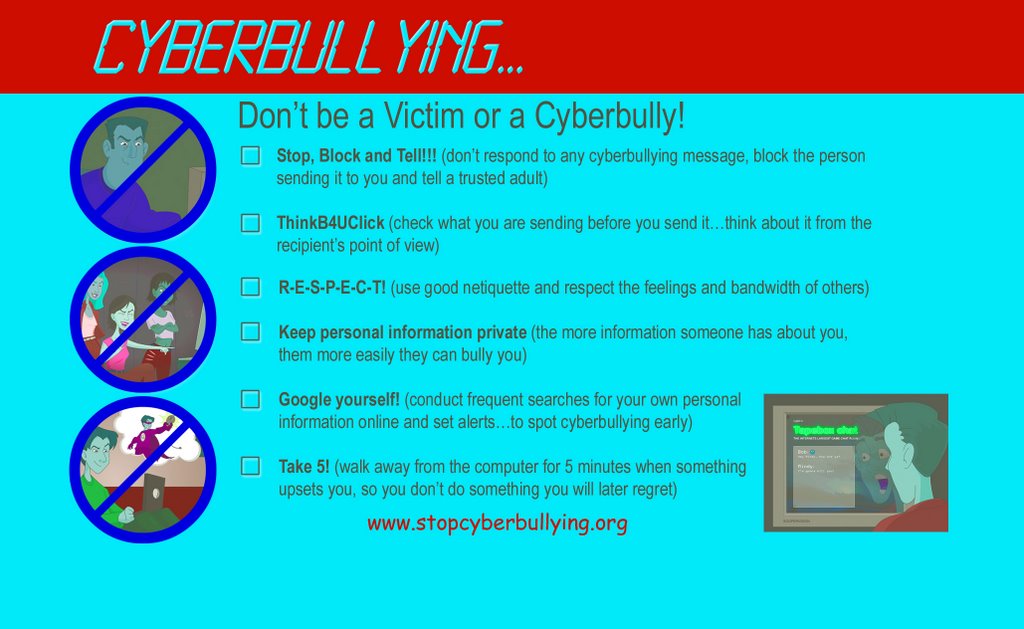
when kids hurt other kids online or using any interactive technological device it's called "cyberbullying."
this public service advertisement teaches kids how to avoid becoming a cyberbully and how to avoid becoming a victim.
Moms and cyberdating...
For years sexual predators have taken advantage of women they marry or date to gain access to their children to molest them. The growth of cyberdating and explosion of social networks for adults who are sharing information about their children (including pictures) have allowed predators to "shop" for the kids and young teens they want to sexually exploit.
Once they identify the kids, meeting the mother and arranging to meet her children is easy.
While many moms are careful about protecting their children from online sexual predators and themselves from cybercreeps, many more don't realize how the Internet can be easily used to give child molesters willing to pose as a lonely boyfriend access to their children.
If you ae cyberdating, be careful to protect yourself. And if you are posting information about yourself online, don't include images or descriptions of your children. At least not if you are advertising to meet someone in real life. If you are cyberdating, take it slower than real life dating. Don't bring the person home and remind your children that they come first. so they will know to trust you with information is this cyberboyfriend does things that make them feel uncomfortable.
it's a hidden risk of cyberdating and cyberrelationships.
be knowledgable...be prepared...be safe.
Parry
Once they identify the kids, meeting the mother and arranging to meet her children is easy.
While many moms are careful about protecting their children from online sexual predators and themselves from cybercreeps, many more don't realize how the Internet can be easily used to give child molesters willing to pose as a lonely boyfriend access to their children.
If you ae cyberdating, be careful to protect yourself. And if you are posting information about yourself online, don't include images or descriptions of your children. At least not if you are advertising to meet someone in real life. If you are cyberdating, take it slower than real life dating. Don't bring the person home and remind your children that they come first. so they will know to trust you with information is this cyberboyfriend does things that make them feel uncomfortable.
it's a hidden risk of cyberdating and cyberrelationships.
be knowledgable...be prepared...be safe.
Parry
Wednesday, October 25, 2006
Tuesday, October 24, 2006
Monday, October 23, 2006
Communication and Education Key to Keeping Kids Safe Online - Government Technology
I am always so proud of the teenangels and they and I were all excited to hear Gina's take on their presentations at the cybersafety summit in California.Communication and Education Key to Keeping Kids Safe Online - Government Technology
Wisconsin State Journal - teenangels
Hortonville Wisconsin teenangels on PBS show.Wisconsin State Journal
thoughts form one of our NJ teenangels about her first presentation to other teens.
When I stepped foot in Howell Middle School, I basically knew I'd be
>talking a bit about things like how to keep kids like ourselves safe on
>the internet as well as how to deal with internet bullying and the
>Teenangels program. It was my first time being part of a formal
>presentation where the audience was more than just my friends and peers
>listening, so I wasn't even expecting kids to really pay attention to
>me or even care about what I had to say. I can definitely say that I
>was shocked at the high participation level of the kids when I did my
>part of the presentation and got them to guess certain statistics and
>let me know what they thought about it. The response gave me this
>remarkable sense - and made us Teenangels realize that we were making
>some sort of a positive difference! Although it was obvious that some
>kids just can't be bothered with caring about anything, I could tell
>that others were certainly affected by some of the stories we brought
>up. I would truly consider it an accomplishment if even one kid made
>changes to be safer online after listening to us speak. At the end of
>the presentation, three girls came up to us and asked us some questions
>and were even surprised to know that most of us had pages up on social
>networking websites like Myspace and Facebook. I think it made them
>realize that we weren't telling them not to do it, but to be safe while navigating them. Bringing that reality to them made them think of us more as role models, rather than teen police!
>Overall, I loved the whole experience and having the opportunity to
>share what we knew with other younger teens who will benefit from it.
>I'm really looking forward to continuing my work as a Teenangel.
>
>talking a bit about things like how to keep kids like ourselves safe on
>the internet as well as how to deal with internet bullying and the
>Teenangels program. It was my first time being part of a formal
>presentation where the audience was more than just my friends and peers
>listening, so I wasn't even expecting kids to really pay attention to
>me or even care about what I had to say. I can definitely say that I
>was shocked at the high participation level of the kids when I did my
>part of the presentation and got them to guess certain statistics and
>let me know what they thought about it. The response gave me this
>remarkable sense - and made us Teenangels realize that we were making
>some sort of a positive difference! Although it was obvious that some
>kids just can't be bothered with caring about anything, I could tell
>that others were certainly affected by some of the stories we brought
>up. I would truly consider it an accomplishment if even one kid made
>changes to be safer online after listening to us speak. At the end of
>the presentation, three girls came up to us and asked us some questions
>and were even surprised to know that most of us had pages up on social
>networking websites like Myspace and Facebook. I think it made them
>realize that we weren't telling them not to do it, but to be safe while navigating them. Bringing that reality to them made them think of us more as role models, rather than teen police!
>Overall, I loved the whole experience and having the opportunity to
>share what we knew with other younger teens who will benefit from it.
>I'm really looking forward to continuing my work as a Teenangel.
>
Sunday, October 22, 2006
Teenangels to the rescue -| Summit tackles Internet sexual predators
MercuryNews.com | 10/19/2006 | Summit tackles Internet sexual predatorsLearn a bit about our incredible teens...
okay...what can we do about cybersafety?
I devote my life to helping people stay safer online and while using wireless and mobile devices. This includes helping kids, preteens and teens do the same and helping parents, siblings and grandparents keep the kids they love safer in cyberspace.
yet, the more I do, the more I have to do. Sometimes I feel like Mickey Mouse in the Sorcerer's apprentice trying to sweep out the raging waters.
This task requires the help and involvedment of many stakeholder groups - parents, extended families ad other caregivers; school administrators, librarians, educators and youth counselors and organizations; legislators, non-profits and governmental agencies; law enforcement, school resource officers and members of the judiciary system; the Internet, mobile technology, gaming and electronic device industries; and the kids, preteens and teens themselves.
In California, the Dept of Consumer Affairs hosted a cybersafety summit sponsored by the Governor of Califorinia. For the first time in the US all major stakeholders were brought together to share our expertise and find ways to collaborate.
It was a welcome change over the sometimes partison conferences, and events designed to promote products or programs of special interest groups.
I had just flown back from Greece where I keynoted a conference sponsored by the EU cybersafety program for Greece. For the first time, we decided to share and license our programs to another group in the field. Our Greek Teenangels program will launch this Fall. And all our educational programs, curricula and materials will be translated and adpated by the group in Greece and delivered on our joint behalf, without charge.
It has been years since we started doing this. WiredSafety is the world's largest and oldest Internet safety group, first starting its work under a prior name in 1995.
Since then, many gorups have been spawned from us and many more have adapted our materials, programs and resources (sometimes even with our permission :-)).
Standing at the podium, where we opened the first panel at the California summit, I looked out over the packed house and saw the other leaders in cybersafety. Marc Klaas, a man I admire greatly, delivered the keynote. The incredible San Francisco DA spoke, along with Chris Kelly (Facebook) and others. Yahoo's Safely team was there, with Catherine Davis, the founder of Yahooligans. So was Google, Microsoft and law enforcement groups galore.
It would have been great to have us all sit down and let us share our thoughts and find ways ot put our egoes behind us and work together. Years ago, there was no one else in the field. A few of us were all there was. I came form cyberlaw and policy, as a privacy and security lawyer. I also used the volunteer approach to get things moving from the grass-roots model. Later our teenangels program became the first (and still only) expert youth training program.
Larry Magid worked from the technology perspective. He used to be a columnist with the LA Times on technology and brought that expertise to the field. He later collaborated with NCMEC and later Anne Collier.
Donna Rice Hughes came at this from the anti-porn perspective, representing the more conservative religious right perspectives. She later branched out into other issues. (Donna wasn't at the event.)
Debbie Mahoney founded the first moms program, soc-um (safeguarding our kids - united mothers), against pedophiles online long before any of us thought about cybersafety, four years before the web was launched.
Now, new groups and experts and wanna-be experts join our ranks daily.
I think it's time to look at what we are doing and find a way to work together. It's time we all join forces and put the kids first. It's time we compete less.
I'm willing. Is anyone else?
it's time...
Parry
yet, the more I do, the more I have to do. Sometimes I feel like Mickey Mouse in the Sorcerer's apprentice trying to sweep out the raging waters.
This task requires the help and involvedment of many stakeholder groups - parents, extended families ad other caregivers; school administrators, librarians, educators and youth counselors and organizations; legislators, non-profits and governmental agencies; law enforcement, school resource officers and members of the judiciary system; the Internet, mobile technology, gaming and electronic device industries; and the kids, preteens and teens themselves.
In California, the Dept of Consumer Affairs hosted a cybersafety summit sponsored by the Governor of Califorinia. For the first time in the US all major stakeholders were brought together to share our expertise and find ways to collaborate.
It was a welcome change over the sometimes partison conferences, and events designed to promote products or programs of special interest groups.
I had just flown back from Greece where I keynoted a conference sponsored by the EU cybersafety program for Greece. For the first time, we decided to share and license our programs to another group in the field. Our Greek Teenangels program will launch this Fall. And all our educational programs, curricula and materials will be translated and adpated by the group in Greece and delivered on our joint behalf, without charge.
It has been years since we started doing this. WiredSafety is the world's largest and oldest Internet safety group, first starting its work under a prior name in 1995.
Since then, many gorups have been spawned from us and many more have adapted our materials, programs and resources (sometimes even with our permission :-)).
Standing at the podium, where we opened the first panel at the California summit, I looked out over the packed house and saw the other leaders in cybersafety. Marc Klaas, a man I admire greatly, delivered the keynote. The incredible San Francisco DA spoke, along with Chris Kelly (Facebook) and others. Yahoo's Safely team was there, with Catherine Davis, the founder of Yahooligans. So was Google, Microsoft and law enforcement groups galore.
It would have been great to have us all sit down and let us share our thoughts and find ways ot put our egoes behind us and work together. Years ago, there was no one else in the field. A few of us were all there was. I came form cyberlaw and policy, as a privacy and security lawyer. I also used the volunteer approach to get things moving from the grass-roots model. Later our teenangels program became the first (and still only) expert youth training program.
Larry Magid worked from the technology perspective. He used to be a columnist with the LA Times on technology and brought that expertise to the field. He later collaborated with NCMEC and later Anne Collier.
Donna Rice Hughes came at this from the anti-porn perspective, representing the more conservative religious right perspectives. She later branched out into other issues. (Donna wasn't at the event.)
Debbie Mahoney founded the first moms program, soc-um (safeguarding our kids - united mothers), against pedophiles online long before any of us thought about cybersafety, four years before the web was launched.
Now, new groups and experts and wanna-be experts join our ranks daily.
I think it's time to look at what we are doing and find a way to work together. It's time we all join forces and put the kids first. It's time we compete less.
I'm willing. Is anyone else?
it's time...
Parry
wcbstv.com - Family First: Parents Guide To Video File Sharing
Video sharing sites and cybersafety. what does wiredsafety.org have to say?wcbstv.com - Family First: Parents Guide To Video File Sharing
Friday, October 20, 2006
Sacramento Hosts Summit on Cyber Safety
Teenangels and Parry join forces with other safety experts and California's governor to "terinate" cyber-risks. :-)Sacramento Hosts Summit on Cyber Safety
Students urged to follow safety rules while online
Art Wolinsky and our Holmdel teens get on their feet to teach kids safer surfing skills. Students urged to follow safety rules while online
Friday, October 13, 2006
Wednesday, October 11, 2006
My angel...."Jazz"
A few years ago I met one of our volunteers. She was caring, well-liked and gentle. She also made the mistake of offering to talk with me about doing more. I am famous for recruiting people for their skills and/or caring. She didn't know that at the time. I saw something special in her, never having met her in RL, judging her only on her online tone.
I tapped her ot help me build teenangels.org into a formidable force, empowering teens to help themselves and each other stay safer online.
I also asked her to cover for me on the John Walsh Show (since cancelled) that was honoring our teenangels. I scanned the audience for her, when I watched the show on TV. All I could see what this beautiful, well-mannered blonde with a warm and wonderful smile sitting in "Jazzangel's" seat. I didn't know who this woman was. It never occured to me that the one who had such a beautiful heart also was beautiful in a classic sense.
Rose (having since given up her screen name as one of the top three execs within WiredSafety.org) has created one of the most effective and efficient teams wiredsafety has ever had, and has taken teenangels from Parry's dream to a national and international reality.
Today she had a special birthday. I won't tell you which, because you would never believe me. I want to thank her for all she has done, and for all she will do...for her vision, patience and kindness...for being my angel and the angel of all those teenangels and tweenangels now and in the future.
Happy Birthday Rose.
with love and thanks,
Parry
I tapped her ot help me build teenangels.org into a formidable force, empowering teens to help themselves and each other stay safer online.
I also asked her to cover for me on the John Walsh Show (since cancelled) that was honoring our teenangels. I scanned the audience for her, when I watched the show on TV. All I could see what this beautiful, well-mannered blonde with a warm and wonderful smile sitting in "Jazzangel's" seat. I didn't know who this woman was. It never occured to me that the one who had such a beautiful heart also was beautiful in a classic sense.
Rose (having since given up her screen name as one of the top three execs within WiredSafety.org) has created one of the most effective and efficient teams wiredsafety has ever had, and has taken teenangels from Parry's dream to a national and international reality.
Today she had a special birthday. I won't tell you which, because you would never believe me. I want to thank her for all she has done, and for all she will do...for her vision, patience and kindness...for being my angel and the angel of all those teenangels and tweenangels now and in the future.
Happy Birthday Rose.
with love and thanks,
Parry
thoughts from teenangels....
Heard in Rye Speaker Series September 12, 2006
Reflections of Kate Coloabella and Gianna Curcio
We as Teenangels (Kate and Gianna) attended Parry Aftab’s seminar in Rye, NY. The Seminar was held for parents who wanted to know more on how to protect their children from the dangers of the Internet. The session began with Ms. Aftab speaking about the developments of Wired Safety and her many other organizations including Teenangels, Tweenangels and her upcoming Wired Moms. Parry Aftab further enlightened the parents on the programs’ policies and views on keeping the internet safe. She advised the group on how to better their child-parent communication, concerning the risks that they might face. All of the crucial points that Ms. Aftab touched on were presented in a slideshow that she created. In the time remaining, the parents had a chance to pose their individual questions for Parry to answer.
We as Teenangels found the seminar to be an interesting and enjoyable experience.
Being that this was our first, certain things came as a surprise to us.
Before the discussion, we knew of only three social networking sites (MySpace, Facebook, Xanga) but, we soon discovered just how wrong we were. When Parry spoke on the subject, the list seemed to go on forever! Also, when the parents were sharing their own experiences with their children on the Internet, we came to find that some knew a lot while others seemed clueless.
From the very beginning of the session one could tell that Parry possessed a certain ease that made her easy to talk to and understand. She was so passionate in her views that the listener could tell that she was definitely in the know. Parry was able to hold the attention of the room, keeping it fun, while discussing serious issues.
Above all, we felt great representing Teenangels worldwide! It was an honor to be recognized as we stood beside Parry Aftab in teaching parents the facts on Internet safety!!
Reflections of Kate Coloabella and Gianna Curcio
We as Teenangels (Kate and Gianna) attended Parry Aftab’s seminar in Rye, NY. The Seminar was held for parents who wanted to know more on how to protect their children from the dangers of the Internet. The session began with Ms. Aftab speaking about the developments of Wired Safety and her many other organizations including Teenangels, Tweenangels and her upcoming Wired Moms. Parry Aftab further enlightened the parents on the programs’ policies and views on keeping the internet safe. She advised the group on how to better their child-parent communication, concerning the risks that they might face. All of the crucial points that Ms. Aftab touched on were presented in a slideshow that she created. In the time remaining, the parents had a chance to pose their individual questions for Parry to answer.
We as Teenangels found the seminar to be an interesting and enjoyable experience.
Being that this was our first, certain things came as a surprise to us.
Before the discussion, we knew of only three social networking sites (MySpace, Facebook, Xanga) but, we soon discovered just how wrong we were. When Parry spoke on the subject, the list seemed to go on forever! Also, when the parents were sharing their own experiences with their children on the Internet, we came to find that some knew a lot while others seemed clueless.
From the very beginning of the session one could tell that Parry possessed a certain ease that made her easy to talk to and understand. She was so passionate in her views that the listener could tell that she was definitely in the know. Parry was able to hold the attention of the room, keeping it fun, while discussing serious issues.
Above all, we felt great representing Teenangels worldwide! It was an honor to be recognized as we stood beside Parry Aftab in teaching parents the facts on Internet safety!!
what you can teach kids and teens in 45 minutes...
I was invited to fly out to a Marine Base in Yuma to work with the teens and kids from their local youth center on cybersafety. We interviewed te of them on camera before I did the presentation. We discussed one on one what they thoughts about cyberrisks and what they would recommend to another preteen or teen to stay safer online. One young girl thought the greatest cyberrisks were related to compauters falling on you. 45 minutes later, she was explaining that people try to trick kids into giving away information to sell them things or trick them, and that you never know who someone is online. Another girl (12 years old) thought that having a myspace if you aren't careful can cost you your life. She also thought that MySpace should keep all boys over 14 off their site.
I have been working with kids for ten years on these matters. They always impress me. My teenangels.org volunteers are among the most talented and expert in the world. But what a few kids can learn in 45 minutes, when someone does a fun and interactive presentation, amazed me. It works.
Want to help? Let's each promise to spend 45 minutes to keep our kids and their friends safer. I'll share with you whatever you need to do it.
Check out the video. Amazing. (I love that ten year old!!!!).
join us...
I have been working with kids for ten years on these matters. They always impress me. My teenangels.org volunteers are among the most talented and expert in the world. But what a few kids can learn in 45 minutes, when someone does a fun and interactive presentation, amazed me. It works.
Want to help? Let's each promise to spend 45 minutes to keep our kids and their friends safer. I'll share with you whatever you need to do it.
Check out the video. Amazing. (I love that ten year old!!!!).
join us...
Tuesday, October 10, 2006
kutv.com - Parent To Parent-New Web Worries For Parents
YouTube...it opens the web up to amazing possibilities. We can (and do) run our safety videos there. It's the first way we could broadcast video in larger files. But it also has risks. Parents should read about our YouTube safety tips, and remember they apply equally to Google video and myspace video among others. You may want to look at our new 3Cs safety program, which allows families to spot risks without having to get a degree from MIT>
kutv.com - Parent To Parent-New Web Worries For Parents
kutv.com - Parent To Parent-New Web Worries For Parents
Monday, October 09, 2006
selling term papers online...it's a crime!
NY law provides that people who sell term papers to others are committing a crime. While the student himself might be discliplined and expelled for using a term paper written by someone else and proffering it as their own, this law is designed to reach the seller.
Recently I was asked if the law would apply to the sale of term papers online. It should. NY (and other states) have what is called a "long arm statute") that permits the state to reach beyod its borders, online and offline, to apply its laws when the person has reason to know that NY state laws might apply to them. While there is a long list of cases and academic writings on this, the short answer is that if the person knows they are dealing with NY residents, is advertising to NY residents or has some kind of contact in NY, the laws could apply.
Several other states have similar laws.
Sale of term papers - NY law:
Title I, Article 5, Section 213-b of the New York State Education Law provides in pertinent part that: "No person shall, for financial consideration, or the promise of financial consideration, prepare, offer to prepare, cause to be prepared, sell or offer for sale to any person any written material which the seller knows, is informed, or has reason to believe is intended for submission as a dissertation, thesis, term paper, essay, report, or other written assignment by a student in a university, college, academy, school, or other educational institution to such institution or to a course, seminar, or degree program held by such institution."
Recently I was asked if the law would apply to the sale of term papers online. It should. NY (and other states) have what is called a "long arm statute") that permits the state to reach beyod its borders, online and offline, to apply its laws when the person has reason to know that NY state laws might apply to them. While there is a long list of cases and academic writings on this, the short answer is that if the person knows they are dealing with NY residents, is advertising to NY residents or has some kind of contact in NY, the laws could apply.
Several other states have similar laws.
Sale of term papers - NY law:
Title I, Article 5, Section 213-b of the New York State Education Law provides in pertinent part that: "No person shall, for financial consideration, or the promise of financial consideration, prepare, offer to prepare, cause to be prepared, sell or offer for sale to any person any written material which the seller knows, is informed, or has reason to believe is intended for submission as a dissertation, thesis, term paper, essay, report, or other written assignment by a student in a university, college, academy, school, or other educational institution to such institution or to a course, seminar, or degree program held by such institution."
selling term papers online...it's a crime!
NY law provides that people who sell term papers to others are committing a crime. While the student himself might be discliplined and expelled for using a term paper written by someone else and proffering it as their own, this law is designed to reach the seller.
Recently I was asked if the law would apply to the sale of term papers online. It should. NY (and other states) have what is called a "long arm statute") that permits the state to reach beyod its borders, online and offline, to apply its laws when the person has reason to know that NY state laws might apply to them. While there is a long list of cases and academic writings on this, the short answer is that if the person knows they are dealing with NY residents, is advertising to NY residents or has some kind of contact in NY, the laws could apply.
Several other states have similar laws.
Sale of term papers - NY law:
Title I, Article 5, Section 213-b of the New York State Education Law provides in pertinent part that: "No person shall, for financial consideration, or the promise of financial consideration, prepare, offer to prepare, cause to be prepared, sell or offer for sale to any person any written material which the seller knows, is informed, or has reason to believe is intended for submission as a dissertation, thesis, term paper, essay, report, or other written assignment by a student in a university, college, academy, school, or other educational institution to such institution or to a course, seminar, or degree program held by such institution."
Recently I was asked if the law would apply to the sale of term papers online. It should. NY (and other states) have what is called a "long arm statute") that permits the state to reach beyod its borders, online and offline, to apply its laws when the person has reason to know that NY state laws might apply to them. While there is a long list of cases and academic writings on this, the short answer is that if the person knows they are dealing with NY residents, is advertising to NY residents or has some kind of contact in NY, the laws could apply.
Several other states have similar laws.
Sale of term papers - NY law:
Title I, Article 5, Section 213-b of the New York State Education Law provides in pertinent part that: "No person shall, for financial consideration, or the promise of financial consideration, prepare, offer to prepare, cause to be prepared, sell or offer for sale to any person any written material which the seller knows, is informed, or has reason to believe is intended for submission as a dissertation, thesis, term paper, essay, report, or other written assignment by a student in a university, college, academy, school, or other educational institution to such institution or to a course, seminar, or degree program held by such institution."
Sunday, October 08, 2006
Behind every picture there's pain....
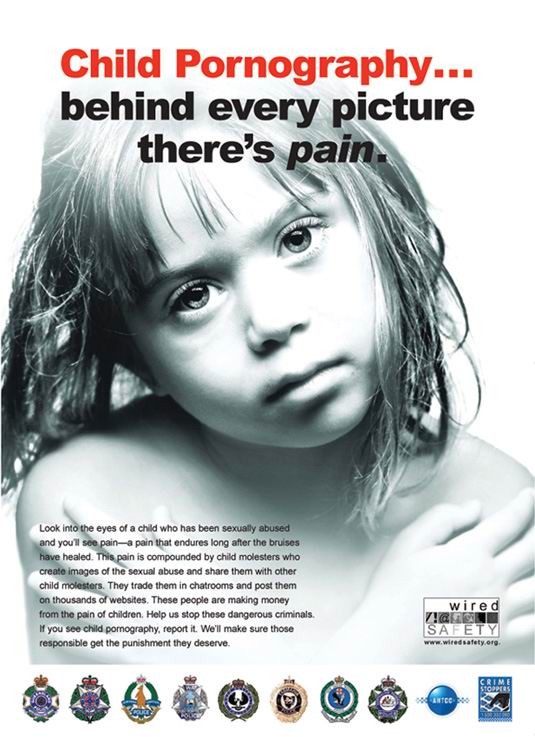
child porn is more than a picture. it's a picture of a crime being committed.
we have to stop it. we have to stop talking. we have to do something.
post this image on your site, blog or profile. If enough people get angry, we can make some changes.
want to help?
visit wiredsafety.org.
I need more help. the problem is getting worse.
it's time.
Parry
The horrors of being a teen online....
I just received a report from a young teen who attends a school where I had done a cybersafety presentation last Spring. She forwarded a link to a child pornography website that had been sent to her, showing young chldren engaged in sexual activities with adults and sometimes other children. She asked me to have it taken down and find the people behind the site.
What do I tell this young teen? Things like this are not what anyone, especially a young teen, should have to see. And the molestation being portrayed is something no child should have to endure.
It's one thing for me to testify before Congress on child pornography in cyberspace. But these are more than just academic issues to be discussed before television cameras. I recently returned from a European Union cybersafety summit in Greece where I was the keyote speaker. I told the story about how I got into all of this. (I saw a picture of a 3-1/2 yr old being raped online. I responded by vomiting, crying and shutting down my law firm to fight against these kinds of things. Thousands joined me in the fight.) Many approached me telling me that it was a moving but depressing beginning to a summit.
A few hours later we learned that the first Greek bust of someone possessing and perhaps trafficking in child porn had just occurred. An infant was molested in a manner I cannot describe. I cried until I couldn't cry anymore and then stared at my computer screen for hours. Why is the problem getting worse? (It is.)
And why do our teens and preteens have to be exposed to adults asking them for their bra size or instructing them on how to engage in real or virtual sex with them?
Children are being hurt every single day. And our teens are subjected to e-mails with links to things we can't imagine in our worse nightmares.
and then I think about Congressmen who have dedicated their time in Congress purportedly to protect children from these kinds of pain. And find out that he has admitted to sending "inappropriate" communications to pages working on the Hill. And his counsel broadcasts that he was molested as a teen, has a problem with alcohol and isn't a pedophile. And that's supposed to excuse this somehow...
It's time that we say "enough!" Enough to excuses for doing things adults should't do to minors (whether or not technically legal under existing laws). Enough for people who think checking into rehab is the right response to doing things that everyone knows is wrong. Enough to people in positions of trust and authority for misusing both.
am I angry?
you bet!
and you should be too.
Parry
What do I tell this young teen? Things like this are not what anyone, especially a young teen, should have to see. And the molestation being portrayed is something no child should have to endure.
It's one thing for me to testify before Congress on child pornography in cyberspace. But these are more than just academic issues to be discussed before television cameras. I recently returned from a European Union cybersafety summit in Greece where I was the keyote speaker. I told the story about how I got into all of this. (I saw a picture of a 3-1/2 yr old being raped online. I responded by vomiting, crying and shutting down my law firm to fight against these kinds of things. Thousands joined me in the fight.) Many approached me telling me that it was a moving but depressing beginning to a summit.
A few hours later we learned that the first Greek bust of someone possessing and perhaps trafficking in child porn had just occurred. An infant was molested in a manner I cannot describe. I cried until I couldn't cry anymore and then stared at my computer screen for hours. Why is the problem getting worse? (It is.)
And why do our teens and preteens have to be exposed to adults asking them for their bra size or instructing them on how to engage in real or virtual sex with them?
Children are being hurt every single day. And our teens are subjected to e-mails with links to things we can't imagine in our worse nightmares.
and then I think about Congressmen who have dedicated their time in Congress purportedly to protect children from these kinds of pain. And find out that he has admitted to sending "inappropriate" communications to pages working on the Hill. And his counsel broadcasts that he was molested as a teen, has a problem with alcohol and isn't a pedophile. And that's supposed to excuse this somehow...
It's time that we say "enough!" Enough to excuses for doing things adults should't do to minors (whether or not technically legal under existing laws). Enough for people who think checking into rehab is the right response to doing things that everyone knows is wrong. Enough to people in positions of trust and authority for misusing both.
am I angry?
you bet!
and you should be too.
Parry
Experts cite need for online parenting (October 8, 2006)
all parents are clueless when their kids online lives are involved. I was too. I just cheat, because I work with teens who help me understand what other teens are doing online.
I cannot say this often enough...IT'S NOT ABOUT TECHNOLOGY - IT'S ABOUT COMMUNICATION AND OLD-FASHIONED RIGHT AND WRONG AND PARENTING. YOUR CHILD MAY KNOW MORE ABOUT TECHNOLOGY THAN YOU DO, BUT YOU KNOW MORE ABOUT LIFE. YOU SHOULD NOT BE YOUR CHILD'S FRIEND. THEY HAVE ENOUGH OF THOSE. YOU SHOULD BE THEIR PARENT. IT'S YOUR JOB TO MAKE SURE THAT THEY UNDERSTAND RIGHT AND WRONG AND YOU ARE THERE TO HELP STEER THEM.
This journalist started the interview with a question, apologizing about asking what non-techy parents should be doing to keep their kids safe online. I explained that no parent knows enough about this. I work with high-tech company execs and software designers who don't know how to do this. why? because kids use the technologies differently from the way we do as adults. So...remember to repeat after me "I am the parent." "Because I said so." "It's my house and when you live in my house you follow MY rules..." got it? sound familiar?
good. :-)Experts cite need for online parenting (October 8, 2006)
I cannot say this often enough...IT'S NOT ABOUT TECHNOLOGY - IT'S ABOUT COMMUNICATION AND OLD-FASHIONED RIGHT AND WRONG AND PARENTING. YOUR CHILD MAY KNOW MORE ABOUT TECHNOLOGY THAN YOU DO, BUT YOU KNOW MORE ABOUT LIFE. YOU SHOULD NOT BE YOUR CHILD'S FRIEND. THEY HAVE ENOUGH OF THOSE. YOU SHOULD BE THEIR PARENT. IT'S YOUR JOB TO MAKE SURE THAT THEY UNDERSTAND RIGHT AND WRONG AND YOU ARE THERE TO HELP STEER THEM.
This journalist started the interview with a question, apologizing about asking what non-techy parents should be doing to keep their kids safe online. I explained that no parent knows enough about this. I work with high-tech company execs and software designers who don't know how to do this. why? because kids use the technologies differently from the way we do as adults. So...remember to repeat after me "I am the parent." "Because I said so." "It's my house and when you live in my house you follow MY rules..." got it? sound familiar?
good. :-)Experts cite need for online parenting (October 8, 2006)
Saturday, October 07, 2006
KTLA The CW | Where Los Angeles Lives | Are Web Sex Predator Watchdogs the Good Guys or Grandstanders?
I haven't been shy about my disregard for the tactics of Perverted Justice. I want bad guys behind bars, not on TV. After the first show, four of those apprehended in the bust called me asking for representation. They had obviously found either my blogs or aftab.com and somehow missed the part about my now donating most of my time to protecting people, especially children, online. I politely declined. :-)
Happily for those of us who care about protecting children online, many cyberpredators are not very bright. They often use their real names and in some highly publicized cases, for top internet executives and homeland security types, send magazine articles about themselves, bragging about their fame, success or something else that ties back to whom they are in real life.
For the last eight years I have donated most of my time and money to my cause of making the Internet safer for everyoe while promoting its use. I take this very seriously. My thousands of volunteers are not paid consultants to TV networks. We have been doing this for 11 years, and do it for love, not money.
I will continue to criticize Perverted Justices work and tactics. Everytime they entrap someone, that predator walks. Those naive enough to plead guilty, instead of finding a qualified lawyer, might find themselves in jail. But anyone with two brain cells to rub together will call a lawyer and given the group's inexperience will probably find an easy out of jail. Embarassed, no doubt, but now better able to avoid the next sting.
my 2 centsKTLA The CW | Where Los Angeles Lives | Are Web Sex Predator Watchdogs the Good Guys or Grandstanders?
Happily for those of us who care about protecting children online, many cyberpredators are not very bright. They often use their real names and in some highly publicized cases, for top internet executives and homeland security types, send magazine articles about themselves, bragging about their fame, success or something else that ties back to whom they are in real life.
For the last eight years I have donated most of my time and money to my cause of making the Internet safer for everyoe while promoting its use. I take this very seriously. My thousands of volunteers are not paid consultants to TV networks. We have been doing this for 11 years, and do it for love, not money.
I will continue to criticize Perverted Justices work and tactics. Everytime they entrap someone, that predator walks. Those naive enough to plead guilty, instead of finding a qualified lawyer, might find themselves in jail. But anyone with two brain cells to rub together will call a lawyer and given the group's inexperience will probably find an easy out of jail. Embarassed, no doubt, but now better able to avoid the next sting.
my 2 centsKTLA The CW | Where Los Angeles Lives | Are Web Sex Predator Watchdogs the Good Guys or Grandstanders?
Wednesday, October 04, 2006
Piczo Plays It Safe
a good article highlighting Piczo's safety practices and I appreciate the heads up about some of their privacy gaps. But one item eeds correction. They didn't retain me. Our safety tips appear as a public service of WiredSafety.org, the watchdog and safety charity I run. Piczo work with us to make sure their site is safer than some of the others. So, they have our tips, but becasue they deserve them, not becasue they hired me to write them :-)
Piczo Plays It Safe
Piczo Plays It Safe
Tuesday, October 03, 2006
Mark Foley - is engaging in sexual discussions with a minor online a crime?
I have been called by legislators, law enforcement and media, all asking the same question - is what Mark Foley did in e-mails or IMs with former pages a crime? Can he be charged with a crime? Although I covered this last night for the ABC Nightly News team who broke this story, it will help others understand what is and what isn't covered by US laws. And, while boring, a review of the law might help us determine if we need more legislation or clarity. The bottomline answer is "It depends on whether there is proof of his intent to engage in more than just chatting about sex." And the jury is still out on that.
Before I lay it out, I need to explain some of the conditions/assumptions. In the US there are state (or local) and there are federal laws. In the case of child sexual exploitation, there are often both state and federal laws, sometimes conflicting and sometimes complementing each other. This response covers Federal laws and references NY laws, as well. (Although I have no reason to believe that NY laws would apply.)
I have seen some of the communications. I am not sure if all of those I reviewed have been made public or not. I suspect that more communications will be discovered as time goes on and more young men or witnesses may come forward. So, this is based on what I have seen to date.
The most important laws covering online communications with minors involving sexual activities is Title 18, Section 2422 (a) covers someone who is trying to get the minor to travel across state lines (and also covers Internet communications as federal commerce) and provides:
"(a) Whoever knowingly persuades, induces, entices, or coerces any individual to travel in interstate or foreign commerce, or in any Territory or Possession of the United States, to engage in prostitution, or in any sexual activity for which any person can be charged with a criminal offense, or attempts to do so, shall be fined under this title or imprisoned not more than 20 years, or both."
Title 18, Section 2422 (b) covers someone who is trying to get a minor to engage in sexual activities which would constitute a crime, and provides:
"(b) Whoever, using the mail or any facility or means of interstate or foreign commerce, or within the special maritime and territorial jurisdiction of the United States knowingly persuades, induces, entices, or coerces any individual who has not attained the age of 18 years, to engage in prostitution or any sexual activity for which any person can be charged with a criminal offense, or attempts to do so, shall be fined under this title and imprisoned not less than 5 years and not more than 30 years."
The important provisions for this law to apply require that 1. the minor is under 18, 2. the adult "knowingly" is involved in this activity, 3. they have gotten the minor to, or are trying to get the minor to, "engage in any sexual activity for which any person can be charged with a criminal offense."
As in all criminal laws within the United States (with a few exceptions not relevant here), intent (or "mens rea") is essential. The prosecution must prove that the person charged with the crime intended to engage in the criminal activity. In this case, the criminal activity would have been engaging in criminal sexual activity with a minor. But just talking about it, without proof of intent to act on it, may not be enough.
The law is very clear that not all sexual activity is covered. Only sexual activity "for which a persona can be charged with a criminal offense." Verbal or written communications, unless they arise to a special level (such as talking about bombs on a plane, or stating that you intend to kill the President, etc.) are generally not criminalized. Images are more likely to be criminalized than written or oral or digital "speech." This has to do with the First Amendment protections and the underpinning belief that words, in most cases, are not dangerous and the ability to speak them should be protected.
In addition, many people say things without intending to do them. The laws in the US are designed to make sure that innocent people are not put in jail. This differs from the premise in some other countries that no guilty person shall go free. Whether you agree or not, it's the basis of the US legal system and reflected throughout our constitution.
With that in mind, let's look at the communications purportedly between Foley and several pages. At least one claimed to be 17, turning 18 on February 23rd next year.
If it could be proven that Foley intended to engage in sexual activity for which a person could be charged with a criminal offense with that young man, he could go to jail. Even consentual sex with this young man, given their age difference, would have been potentially criminal if it occurred before the young man's birthday.
At what point did his activity become criminal? At what point merely fantasy? Was he prepared to act on his discussions or just have discussions? The answer to that is what will determine the legality or criminality of his actions.
A longstanding NY law covers "grooming" which is when adults engage minors in sexual communications designed to entice them into sexual activities. It works both online and offline. In the UK, "grooming" laws were implemented without the challenge of the First Amendment of the US Constitution. The NY law criminalizes the sending of "indecent" content to minors.
The law provides:
NY CLS Penal § 235.22 (2006)
§ 235.22. Disseminating indecent material to minors in the first degree
A person is guilty of disseminating indecent material to minors in the first degree when:
1. knowing the character and content of the communication which, in whole or in part, depicts actual or simulated nudity, sexual conduct or sado-masochistic abuse, and which is harmful to minors, he intentionally uses any computer communication system allowing the input, output, examination or transfer, of computer data or computer programs from one computer to another, to initiate or engage in such communication with a person who is a minor; and
2. by means of such communication he importunes, invites or induces a minor to engage in sexual intercourse, oral sexual conduct or anal sexual conduct, or sexual contact with him, or to engage in a sexual performance, obscene sexual performance, or sexual conduct for his benefit.
Disseminating indecent material to minors in the first degree is a class D felony.
In 2004 the NY courts in The State of NY v. Jeffrey Skya (2004 NY Slip Op 24442; 6 Misc. 3d 188; 789 N.Y.S.2d 403; 2004 N.Y. Misc. LEXIS 2158 decided October 29, 2004)
(looked at a challenege to this law, which was based on the fact that no images were used, only graphic discussions of sexual activity. Without an image, the defendant contended, the law could not apply. The judge disagreed.
He looked instead to the Oxford University Press dictionary which "defines "depict as 1). Represent by a drawing, painting or other art form; 2). Portray in words. The Thesaurus gives the following synonyms for depict: describe, draw, delineate. It is therefore clear to this Court that the "plain meaning" of depict includes words and is not limited to only visual images."
he then went on to explain that "the statute prohibits the communication which depicts actual or simulated sexual conduct. "Simulated" is defined by the Penal Law as follows: "the explicit depiction or description of any of the type of conduct described....which creates the appearance of such conduct." Penal Law Section 235.00(6).(emphasis supplied)."
In dismissing the defendant's challenge, the judge stated that "Clearly the legislature enacted this law to address the growing concern over pedophiles communicating with minors over the computer network regarding sex and luring the minor into a sexual relationship. "The legislative use of inherently imprecise language does not render a statute fatally vague so long as that language conveys sufficiently definite warning as to the proscribed conduct when measured by common understanding and practice." People v. Shack, 86 N.Y.2d 529, 538, 658 N.E.2d 706, 634 N.Y.S.2d 660 (1995). Penal Law Section 235.22 clearly puts an offender on notice of what conduct is prohibited, i.e., sexually oriented computer communication with a minor for the purpose of inducing or inviting that child to engage in sexual conduct with the adult."
The existing federal laws do not read "depiction" as broadly as the NY law does.
I was just informed that the NY law was recently successfully challenged, finding that words alone (without images) were insufficient to trigger the criminal law. I was told a case came down in July. I will look into this.
so, until then, the answer to whether Foley's actions are criminal, based on his discussions without more, is "not sure."
a lawyerly answer if I ever heard one. :-)
Before I lay it out, I need to explain some of the conditions/assumptions. In the US there are state (or local) and there are federal laws. In the case of child sexual exploitation, there are often both state and federal laws, sometimes conflicting and sometimes complementing each other. This response covers Federal laws and references NY laws, as well. (Although I have no reason to believe that NY laws would apply.)
I have seen some of the communications. I am not sure if all of those I reviewed have been made public or not. I suspect that more communications will be discovered as time goes on and more young men or witnesses may come forward. So, this is based on what I have seen to date.
The most important laws covering online communications with minors involving sexual activities is Title 18, Section 2422 (a) covers someone who is trying to get the minor to travel across state lines (and also covers Internet communications as federal commerce) and provides:
"(a) Whoever knowingly persuades, induces, entices, or coerces any individual to travel in interstate or foreign commerce, or in any Territory or Possession of the United States, to engage in prostitution, or in any sexual activity for which any person can be charged with a criminal offense, or attempts to do so, shall be fined under this title or imprisoned not more than 20 years, or both."
Title 18, Section 2422 (b) covers someone who is trying to get a minor to engage in sexual activities which would constitute a crime, and provides:
"(b) Whoever, using the mail or any facility or means of interstate or foreign commerce, or within the special maritime and territorial jurisdiction of the United States knowingly persuades, induces, entices, or coerces any individual who has not attained the age of 18 years, to engage in prostitution or any sexual activity for which any person can be charged with a criminal offense, or attempts to do so, shall be fined under this title and imprisoned not less than 5 years and not more than 30 years."
The important provisions for this law to apply require that 1. the minor is under 18, 2. the adult "knowingly" is involved in this activity, 3. they have gotten the minor to, or are trying to get the minor to, "engage in any sexual activity for which any person can be charged with a criminal offense."
As in all criminal laws within the United States (with a few exceptions not relevant here), intent (or "mens rea") is essential. The prosecution must prove that the person charged with the crime intended to engage in the criminal activity. In this case, the criminal activity would have been engaging in criminal sexual activity with a minor. But just talking about it, without proof of intent to act on it, may not be enough.
The law is very clear that not all sexual activity is covered. Only sexual activity "for which a persona can be charged with a criminal offense." Verbal or written communications, unless they arise to a special level (such as talking about bombs on a plane, or stating that you intend to kill the President, etc.) are generally not criminalized. Images are more likely to be criminalized than written or oral or digital "speech." This has to do with the First Amendment protections and the underpinning belief that words, in most cases, are not dangerous and the ability to speak them should be protected.
In addition, many people say things without intending to do them. The laws in the US are designed to make sure that innocent people are not put in jail. This differs from the premise in some other countries that no guilty person shall go free. Whether you agree or not, it's the basis of the US legal system and reflected throughout our constitution.
With that in mind, let's look at the communications purportedly between Foley and several pages. At least one claimed to be 17, turning 18 on February 23rd next year.
If it could be proven that Foley intended to engage in sexual activity for which a person could be charged with a criminal offense with that young man, he could go to jail. Even consentual sex with this young man, given their age difference, would have been potentially criminal if it occurred before the young man's birthday.
At what point did his activity become criminal? At what point merely fantasy? Was he prepared to act on his discussions or just have discussions? The answer to that is what will determine the legality or criminality of his actions.
A longstanding NY law covers "grooming" which is when adults engage minors in sexual communications designed to entice them into sexual activities. It works both online and offline. In the UK, "grooming" laws were implemented without the challenge of the First Amendment of the US Constitution. The NY law criminalizes the sending of "indecent" content to minors.
The law provides:
NY CLS Penal § 235.22 (2006)
§ 235.22. Disseminating indecent material to minors in the first degree
A person is guilty of disseminating indecent material to minors in the first degree when:
1. knowing the character and content of the communication which, in whole or in part, depicts actual or simulated nudity, sexual conduct or sado-masochistic abuse, and which is harmful to minors, he intentionally uses any computer communication system allowing the input, output, examination or transfer, of computer data or computer programs from one computer to another, to initiate or engage in such communication with a person who is a minor; and
2. by means of such communication he importunes, invites or induces a minor to engage in sexual intercourse, oral sexual conduct or anal sexual conduct, or sexual contact with him, or to engage in a sexual performance, obscene sexual performance, or sexual conduct for his benefit.
Disseminating indecent material to minors in the first degree is a class D felony.
In 2004 the NY courts in The State of NY v. Jeffrey Skya (2004 NY Slip Op 24442; 6 Misc. 3d 188; 789 N.Y.S.2d 403; 2004 N.Y. Misc. LEXIS 2158 decided October 29, 2004)
(looked at a challenege to this law, which was based on the fact that no images were used, only graphic discussions of sexual activity. Without an image, the defendant contended, the law could not apply. The judge disagreed.
He looked instead to the Oxford University Press dictionary which "defines "depict as 1). Represent by a drawing, painting or other art form; 2). Portray in words. The Thesaurus gives the following synonyms for depict: describe, draw, delineate. It is therefore clear to this Court that the "plain meaning" of depict includes words and is not limited to only visual images."
he then went on to explain that "the statute prohibits the communication which depicts actual or simulated sexual conduct. "Simulated" is defined by the Penal Law as follows: "the explicit depiction or description of any of the type of conduct described....which creates the appearance of such conduct." Penal Law Section 235.00(6).(emphasis supplied)."
In dismissing the defendant's challenge, the judge stated that "Clearly the legislature enacted this law to address the growing concern over pedophiles communicating with minors over the computer network regarding sex and luring the minor into a sexual relationship. "The legislative use of inherently imprecise language does not render a statute fatally vague so long as that language conveys sufficiently definite warning as to the proscribed conduct when measured by common understanding and practice." People v. Shack, 86 N.Y.2d 529, 538, 658 N.E.2d 706, 634 N.Y.S.2d 660 (1995). Penal Law Section 235.22 clearly puts an offender on notice of what conduct is prohibited, i.e., sexually oriented computer communication with a minor for the purpose of inducing or inviting that child to engage in sexual conduct with the adult."
The existing federal laws do not read "depiction" as broadly as the NY law does.
I was just informed that the NY law was recently successfully challenged, finding that words alone (without images) were insufficient to trigger the criminal law. I was told a case came down in July. I will look into this.
so, until then, the answer to whether Foley's actions are criminal, based on his discussions without more, is "not sure."
a lawyerly answer if I ever heard one. :-)
Subscribe to:
Posts (Atom)