Friday, March 15, 2013
It's been a busy week - Charlie Sheen's rants about a ten yr old
It's been a crazy and busy week for online abuses. Charlie Sheen used his digital pulpit to attack a prestigious private school in LA-area that his daughter used to attend. Apparently, he claims that a classmate (when they were both 9 years old) bullied his daughter. He was unhappy with how they addressed the problem and withdrew his daughter from the school last year. Now, a year later he tweets that people should deface and attack the school and even names the girl he accuses of bullying his daughter last year. While most parents of bullying targets experience frustration over the handling of bullying and cyberbullying by the school, most do not encourage provokes against the school or retaliation against a ten year old.
I just shot an interview for Inside Edition on this case. They asked me if what Charlie Sheen did was itself "cyberbullying." It's not. It's stupid. It's putting students, the school's teachers and administration at risk for physical and digital attacks. It puts the ten year old he accuses of bullying in the cross-hairs of any crazies who actually follow Charlie Sheen.
It will hurt his daughter far more than he knows, as well.
It's a shame that we put digital weapons like twitter into the hands of adults who act like children and put the lives, safety and emotional well-being of ten year olds at risk.
shame on him!


Wednesday, February 27, 2013
support Congress's move to help our kids become better skilled in math and science!
Bill Summary & Status - 113th Congress (2013 - 2014) - H.RES.77 - THOMAS (Library of Congress)
Following in the shoes of Canada's digital living labs, US youth will have the opportunity to compete in an app challenge. this is a great program. support it!
Following in the shoes of Canada's digital living labs, US youth will have the opportunity to compete in an app challenge. this is a great program. support it!
Thursday, February 14, 2013
Valentines Day - time for romance, love and disrobing online! Seniors Alert!
I am always interviewed and speak about kids sexting and disrobing online...they engage in cybersex (sexual chat) and pose in provocative ways. We warn them about repercussions. We lecture about risks and consequences. We tell them to keep their hormones in check.
But, while sexting among young people is a growing problem, so is sexting among seniors and single and not-so-single adults. I get as many emails from grandparents asking how to delete a sexy pic they shared with someone online as I do from grandparents worried about their grandchildren.
While visions of 85 year olds in the buff may not be a turn-on for most of us, they apparently are for other seniors who are lonely, love-starved and still active libidos. They do it for the same reason kids do. To get someone's attention. To show they care. To share how much they care. They may do it while intoxicated or on medication and not thinking clearly. Or they may do it when not thinking at all.
But mirroring their younger counterparts, they worry about what will happen if the image "gets out". They worry about family members seeing it, or neighbors, or pastors, rabbis and priests.
So, this Valentine's Day, show love in other ways. If you are going to take off your clothes, do it in person and make sure the cameras are off and stay that way.
Saturday, February 09, 2013
Finding Love in all the CyberPlaces - why we love to love online
I gave an interview to the Buffalo News last week. It ran today. I was asked about why people engage in online romances. We talked about the typical issues of loneliness, disconnectedness, fear of being hurt....But there are many more of us who do it becasue it saves time. Time we don't have with 24/7 ever-connected jobs. We live in isolation. Work in isolation. Commute in isolation. We at, drink and play in isolation too often as well. Who has time for getting dressed up? High heels hurt and shaving after you get home form a long day at work? Sometimes not worth the trouble.
Cyberdating allows us to sit at home, in our bunny slippers with chinese take-out and fit cybersex and cyber-romance between episode of Game of Thrones and Girls. We don't have to straighten our apartments, empty the sink or put out dip. We don't have to worry about STDs, pregnancy or our kids walking in on us.
When I do CNN or other news programs, or am shot for TV from my home, I often get dressed for the camera from the waist up. no one sees that I am barefoot or in my favorite sweatpants. The camera sees what you want it to see. Wearing a facial mask or had a bad skin/hair/body day/week/lifetime? No prob. Put an "out of order" notice on your webcam and do a low sexy voice instead...
Sometimes, dating isn't worth the effort. And cyberdating allows us to expend as little or as much effort as we want. It's cleaner, faster and easier.
Cyberdating is becoming a relationship of convenience. It's not for kids anymore. (Never was, actually.)
As we think about love this Valentines Day, let's think about taking it a step further...maybe even dialing the phone! :-)
a snow day - kids reach out for help online
This past Friday most of the NE coast schools were closed for the blizzard. When I was growing up, snow days meant we could go sledding, build snowmen and forts or lay on the sofa reading books with a cup of hot chocolate. This Friday, however, WiredSafety and our StopCyberbullying helpline received four times the normal number of inquiries and calls for help. Why? We're not certain, but think it has to do with the brief break in the school schedule and the time and need to report cyberbullying.
It only reminds us that if our kids spent more time building snow forts and throwing snowballs, they might have fewer problems online. Many cyberbullies act out for entertainment. They do it to fill boring time.
And targets of cyberbullying will feel better when they are laughing and ducking well-aimed snowballs than sitting in their rooms brooding over online insults.
Our studies have shown that online drama is seriously reduced with kids who are athletes. Whether it's the reduced time, energy or focus, or working off excess teen hormones and cortisol, offline sports reduces online angst.
So, put on your mittens and UGGs and laugh a little with your kids. It's good for everyone and will keep them safer online. Who knew?
Thursday, February 07, 2013
A Golden Opportunity Seized! Thank you Gov Christie
A Golden Opportunity Seized
I wrote an Op-Ed for the Star Ledger Monday asking Governor Christie to seize the opportunity to protect all consumers - especially our children- from the risks of unregulated online gambling. I just learned that he conditionally vetoed the bill, but once it is amended to build in better protections of problem gamblers, he indicated that he will sign it. This is wonderful news and speaks to his continued leadership in our state and across the country.
Today's conditional veto of online gambling legislation by New Jersey Governor Chris Christie is an important step forward in protecting consumers
- especially children - online. Governor Christie understands that we have to regulate online gaming, instead of continuing to ignore it. He has expressed concern over online problem gambling, which is commendable. To address this concern, today he charged the New Jersey State Legislature with amending the bill to include increased funding for compulsive gambling treatment programs. He also requested an annual analysis of online gambling's impact on problem gambling. This can act as an early warning system to allow the state to address any issues before they get out of hand.
Thank you, Governor Christie, for seizing this golden opportunity to protect New Jersey's families. Good work! Once again, you make me proud to be from New Jersey!
Saturday, December 22, 2012
Alex Wonder: New free downloadable game helps kids fight cyberbullying
Alex Wonder: New game helps kids fight cyberbullying
Everything a teacher needs to help students understand how to spot cyberbullying behavior in themselves and others, understand what to do about it once it begins and how to avoid it. It's a free download from stopcyberbullying.org.
Everything a teacher needs to help students understand how to spot cyberbullying behavior in themselves and others, understand what to do about it once it begins and how to avoid it. It's a free download from stopcyberbullying.org.
Violence in Video Games
Every year we experience a tragedy in real life where the person responsible turns out to be a video gamer, with favorite games such as world of warcraft and gears of war. And immediately following the evidence that the person charged with the violent crime is a gamer, there is an outcry to ban violent video games.
I wish it were that simple.
I wish that by banning content and certain interactive networks, we could curtail violence.
In my generation we all had cap pistols and bows and arrows to play with. Shooting each other on the playground with these toy guns was commonplace.
My son's generation included GI Joe and teh shooting continued.
War, weapons, shooting and killing were part of play since I was born (and I am sure beyond).
We blamed violence in the media. Violent music lyrics. Movies like Psycho, Halloween and Terminator for stirring up violence in our youth.
And now, we blame violent games.
Tragedies such as Newtown, grieve us all. Lost children, the promises unfulfilled, make us want to lock up our children until they reach the age of fifty to protect them from hate, violence and fear.
Gamers include people of all ages, talents, nationalities, ethnic background, shapes, sizes, religions, races and temperments. The games provide an outlet, entertainment and helps develop strategic thinking.
Of course, some gamers are violent, just as some may be timid. Some are hateful as others may be kind. Some are very bright and others don't have two brain cells to rub together.
It's not the gaming, or the game. It's the violent actor we should be banning, studying and finding ways to disarm.
Let's not take the easy and ineffective way out. It's not technology we should be blaming. It's the bad actors.
Wednesday, December 19, 2012
COPPA 2.0 - Amended Children’s Online Privacy Protection Rule
It's been 18 mos since we started reviewing COPPA to see what should be kept, and what should be abandoned. The world of children online has changed dramatically since COPPA was first adopted in October 1998. The FTC gave the industry 1-1/2 years to prepare and it first became effective in April 2000.
Even then, most companies failed to comply.
Over the years, many smaller (and embarassingly larger) industry members have complied by copying another site's privacy policy and claiming in big bold letters that they were compliant with COPPA.
They failed to realize that by doing so, they were making it worse when the stolen privacy policy didn't match their site's practices.
Now, the Internet as we knew it is not a desktop world anymore. Handhelds, mobile devices and technologies use different networks to connect everyone, especially kids. And none of us over the age of 15 know how to do what our kids do and what to do to keep them safe.
Some of us worried that COPPA 2.0 was taking on too much. Some advocates wanted the age raised to 16 (from 12 and under). Others wanted heavy regulations on advertisers marketing to kids, and many wanted nothing to change.
I filed two comments (one for each comment period) and assisted in drafting others for clients and companies I advise. I was worried that the knowledge standard would be changed somehow, bring an "implied" standard to the table in knowing the age of your users. I worried that plug-in providers would have a higher duty to inquire about the user demographics. I worried that in an attempt to keep our children safer and more private, we were turning off the technologies and keaving them in the dark.
I had no need to worry. With few exceptions, the new COPPA Rule tracked my wishlist and comments. It reflects how much the FTC listened to all stakeholders and how carefully they weighed the risks and benefits of a more exacting regime.
I am a fan of the current FTC Chairman. I have been since he was first selected as an FTC Commissioner. But even more, I am a fan of the people at the FTC who work tirelessly to be always available to industry and advocates alike.
We joke about the Call Phyliis and Mamie hotline (referring to Mamie Kresses and Phyllis Marcus, the COPPA mavins at the FTC), referring to their willingness to be there for questions and for ideas.
I wish all federal agencies worked as well, and cared so much.
So, for my clients which are waiting with baited breath for my guidance on COPPA 2.0, I will be in touch tomorrow. And for the rest, it's not so bad and with the right help, not so hard.
Parry
FTC Strengthens Kids’ Privacy, Gives Parents Greater Control Over Their Information By Amending Children’s Online Privacy Protection Rule
Even then, most companies failed to comply.
Over the years, many smaller (and embarassingly larger) industry members have complied by copying another site's privacy policy and claiming in big bold letters that they were compliant with COPPA.
They failed to realize that by doing so, they were making it worse when the stolen privacy policy didn't match their site's practices.
Now, the Internet as we knew it is not a desktop world anymore. Handhelds, mobile devices and technologies use different networks to connect everyone, especially kids. And none of us over the age of 15 know how to do what our kids do and what to do to keep them safe.
Some of us worried that COPPA 2.0 was taking on too much. Some advocates wanted the age raised to 16 (from 12 and under). Others wanted heavy regulations on advertisers marketing to kids, and many wanted nothing to change.
I filed two comments (one for each comment period) and assisted in drafting others for clients and companies I advise. I was worried that the knowledge standard would be changed somehow, bring an "implied" standard to the table in knowing the age of your users. I worried that plug-in providers would have a higher duty to inquire about the user demographics. I worried that in an attempt to keep our children safer and more private, we were turning off the technologies and keaving them in the dark.
I had no need to worry. With few exceptions, the new COPPA Rule tracked my wishlist and comments. It reflects how much the FTC listened to all stakeholders and how carefully they weighed the risks and benefits of a more exacting regime.
I am a fan of the current FTC Chairman. I have been since he was first selected as an FTC Commissioner. But even more, I am a fan of the people at the FTC who work tirelessly to be always available to industry and advocates alike.
We joke about the Call Phyliis and Mamie hotline (referring to Mamie Kresses and Phyllis Marcus, the COPPA mavins at the FTC), referring to their willingness to be there for questions and for ideas.
I wish all federal agencies worked as well, and cared so much.
So, for my clients which are waiting with baited breath for my guidance on COPPA 2.0, I will be in touch tomorrow. And for the rest, it's not so bad and with the right help, not so hard.
Parry
FTC Strengthens Kids’ Privacy, Gives Parents Greater Control Over Their Information By Amending Children’s Online Privacy Protection Rule
Tuesday, December 18, 2012
COPPA Rule Changes - what do they mean for you, your family and your network?
Thirteen years ago one of the most powerful children's privacy laws in the world took effect. It required commercial networks, providers and websites (including game networks) to give parents notice of and get permission before collecting information from their preteens or enabling preteens to communicate and share personal information with others.
The law has been studied and used as a model for many kids privacy regulatory schemes around the world.
Several of us were actively involved in its drafting and clarification. I wrote most of the privacy policies for children's networks, websites and game providers in April 2000 when it became effective. Visit aftab.com for the history of COPPA and my thoughts on what works and what doesn't.
Since then, I have continued to advise the industry leaders in COPPA compliance. We have designed several digital tools and helped set industry best practice standards for kids privacy, safety and security. It's not easy, but worth the effort. And failure to comply has resulted in fines exceeding $1 million for brand names, such as Sony.
At noon the newly revised COPPA Rules will be announced, after 18 months of comments, revisions and unput from the industry, child advocates and parents. We can only guess (although many of us have educated guesses :-)) what changes will be reflected in the new rule.
But whatever the case, the networks, websites, services, digital tool providers, mobile operators and entertainment providers will have to work changes in their current practices to comply with these changes.
As parents, read the privacy policies that so many ignore. It's worth it to understand what providers are doing to protect your child's privacy.
As kids, don't lie about your age to pretend to be 13 or older. It's not worth the risk. There are so many great sites and services for preteens. And, your parents can give permission for you to use sites that allow preteens with parents' consent.
It you are a provider, network or operator to which the new COPPA Rule applies, get experienced counsel who can walk you through the kids privacy landmines.
Visit WiredTrust.com if you need help. Check out the SociallySafe.com kids seal on best practices.
Parry
The law has been studied and used as a model for many kids privacy regulatory schemes around the world.
Several of us were actively involved in its drafting and clarification. I wrote most of the privacy policies for children's networks, websites and game providers in April 2000 when it became effective. Visit aftab.com for the history of COPPA and my thoughts on what works and what doesn't.
Since then, I have continued to advise the industry leaders in COPPA compliance. We have designed several digital tools and helped set industry best practice standards for kids privacy, safety and security. It's not easy, but worth the effort. And failure to comply has resulted in fines exceeding $1 million for brand names, such as Sony.
At noon the newly revised COPPA Rules will be announced, after 18 months of comments, revisions and unput from the industry, child advocates and parents. We can only guess (although many of us have educated guesses :-)) what changes will be reflected in the new rule.
But whatever the case, the networks, websites, services, digital tool providers, mobile operators and entertainment providers will have to work changes in their current practices to comply with these changes.
As parents, read the privacy policies that so many ignore. It's worth it to understand what providers are doing to protect your child's privacy.
As kids, don't lie about your age to pretend to be 13 or older. It's not worth the risk. There are so many great sites and services for preteens. And, your parents can give permission for you to use sites that allow preteens with parents' consent.
It you are a provider, network or operator to which the new COPPA Rule applies, get experienced counsel who can walk you through the kids privacy landmines.
Visit WiredTrust.com if you need help. Check out the SociallySafe.com kids seal on best practices.
Parry
The News Reports on Instagram's Ownership of Your Photos are Not True
Thank you, and we’re listening - Instagram Blog From time to time, when privacy policies are changed, people misread them and think their fears have come true. Today I heard several news reports claiming that you give up your ownership of your photos posted on Instagram, and they will now being selling them to advertisers. Not true.
I wish lawyers wrote privacy policies more clearly...
do not fear. Your rights are still protected.
Parry
I wish lawyers wrote privacy policies more clearly...
do not fear. Your rights are still protected.
Parry
Sunday, December 16, 2012
As nation mourns, investigators try to figure out what led to tragedy in Newtown, Conn. | Fox News
As nation mourns, investigators try to figure out what led to tragedy in Newtown, Conn. | Fox News
I have been in the child safety space for 18 years. I track bullycides, offline violence caused by online communications, self-harm and mass-killings of children.
Each time gets harder.
We seek solutions and approaches afterwards. Lots of approaches, lots of activities following a tragedy. But we don't know how effective they are.
How do we measure prevention?
How do we measure the deaths and harm that didn't happen becasue of our empathy-training, community policing efforts and educators trained to spot students who are at risk?
I am often asked if crimes are increasing, or if we are just more aware of them now. I am not sure i can answer that question. I know we have to keep on fighting the good fight and hope that the story we never read about is the crime we prevented.
Otherwise, how can we live with kindergardners being gunned down?
Our prayers and thoughts are with the grieving family and loved ones...
Parry
I have been in the child safety space for 18 years. I track bullycides, offline violence caused by online communications, self-harm and mass-killings of children.
Each time gets harder.
We seek solutions and approaches afterwards. Lots of approaches, lots of activities following a tragedy. But we don't know how effective they are.
How do we measure prevention?
How do we measure the deaths and harm that didn't happen becasue of our empathy-training, community policing efforts and educators trained to spot students who are at risk?
I am often asked if crimes are increasing, or if we are just more aware of them now. I am not sure i can answer that question. I know we have to keep on fighting the good fight and hope that the story we never read about is the crime we prevented.
Otherwise, how can we live with kindergardners being gunned down?
Our prayers and thoughts are with the grieving family and loved ones...
Parry
Monday, December 10, 2012
FTC's Second Kids' App Report Finds Mobile App Privacy Problems for Kids
FTC's Second Kids' App Report Finds Little Progress in Addressing Privacy Concerns Surrounding Mobile Applications for Children
Many mobile app developers are good at coding, but know nothing about legal compliance and even less about kids privacy.
The FTC has ruled that mobile app developers are subject to COPPA (the children's online privacy protection act), which since 2000 has governed what digital developers and networks can collect from preteens or allowed to be shared with others about preteens.
Fines in the space have exceeded $1 million and those fined have included such stellar brands as Sony.
Some parts of the law are tricky, especially when the technology changes every nano second. But the basics are simple.
1. If you knowingly have preteens signing up for your mobile app, the law applies.
2. If your mobile app is directed at young teens or preteens, it applies.
3. The app needs a link to a privacy policy or privacy info embedded into the app (and easily found).
4. The app needs to be up front about what it is collecting from users and from the digital device (GPS, other app usage, social networking accounts, photo sharing accounts, etc.)
then, they need to walk the walk. what they say needs to match what they are doing. Too many developers to save time, effort and legal fees merely copy someone else's privacy policy. But if it doesn't match their privacy practices, they can also be charged with consumer fraud.
My new consulting firm, Wiredtrust.com, offers legal guidance, privacy best practices and the first safety and best practices seal for kids sites, Socially Safe Kids.

Many mobile app developers are good at coding, but know nothing about legal compliance and even less about kids privacy.
The FTC has ruled that mobile app developers are subject to COPPA (the children's online privacy protection act), which since 2000 has governed what digital developers and networks can collect from preteens or allowed to be shared with others about preteens.
Fines in the space have exceeded $1 million and those fined have included such stellar brands as Sony.
Some parts of the law are tricky, especially when the technology changes every nano second. But the basics are simple.
1. If you knowingly have preteens signing up for your mobile app, the law applies.
2. If your mobile app is directed at young teens or preteens, it applies.
3. The app needs a link to a privacy policy or privacy info embedded into the app (and easily found).
4. The app needs to be up front about what it is collecting from users and from the digital device (GPS, other app usage, social networking accounts, photo sharing accounts, etc.)
then, they need to walk the walk. what they say needs to match what they are doing. Too many developers to save time, effort and legal fees merely copy someone else's privacy policy. But if it doesn't match their privacy practices, they can also be charged with consumer fraud.
My new consulting firm, Wiredtrust.com, offers legal guidance, privacy best practices and the first safety and best practices seal for kids sites, Socially Safe Kids.

Monday, July 16, 2012
NYC taxpayers may have to pay for private school for bullying victim - NYPOST.com
EXCLUSIVE: NYC taxpayers may have to pay for private school for bullying victim - NYPOST.com
Unfortunately, this article was too short to address the real issue here: The Federal Ct Judge looked to the Dear Colleague Letter issued in 2010 by the Secretary of Education in Washington. Until this case, courts looked to standards of safety/security for students on school grounds during the school day for determining the school's liability.
The Dear Colleague Letter was issued following a by-invitation-only DoE/DOJ/DHHS summit of roughly 100 of us (bullying and cyberbullying experts) hosted in DC. The letter clarified the schools' obligations to assert authority when students' civil rights are impacted by bullying in any form.
But whether the Dear Colleague Letter was intended to create a new legal standard or not is not clear.
Given the large number of bullying and cyberbullying incidents in schools and the unfortunate inability of schools to address these adequately, special needs students (if this is upheld on appeal) will by and large be entitled to private school education at the taxpayers' expense. And this standard will make it easier to sue school districts on the new Dear Colleague standards.
An unintended or intended consequence?
I'll ask the Secretary of Education when the next summit is held in August.
But for NY taxpayers, this may be too little/too late.
Unfortunately, this article was too short to address the real issue here: The Federal Ct Judge looked to the Dear Colleague Letter issued in 2010 by the Secretary of Education in Washington. Until this case, courts looked to standards of safety/security for students on school grounds during the school day for determining the school's liability.
The Dear Colleague Letter was issued following a by-invitation-only DoE/DOJ/DHHS summit of roughly 100 of us (bullying and cyberbullying experts) hosted in DC. The letter clarified the schools' obligations to assert authority when students' civil rights are impacted by bullying in any form.
But whether the Dear Colleague Letter was intended to create a new legal standard or not is not clear.
Given the large number of bullying and cyberbullying incidents in schools and the unfortunate inability of schools to address these adequately, special needs students (if this is upheld on appeal) will by and large be entitled to private school education at the taxpayers' expense. And this standard will make it easier to sue school districts on the new Dear Colleague standards.
An unintended or intended consequence?
I'll ask the Secretary of Education when the next summit is held in August.
But for NY taxpayers, this may be too little/too late.
Tuesday, February 14, 2012
Thursday, January 19, 2012
When is a hateful comment a hate crime? NJ police investigate possible biased Wi-Fi ID | Deseret News
NJ police investigate possible biased Wi-Fi ID | Deseret NewsSomeone in Bergen County, NJ (a diverse, well-educated and generally affluent county)use a hateful phrase as his WiFi handle. Someone in the community was searching for an open WiFi and stumbled upon this hateful handle. This was brought to law enforcement's attention. Unless someone hacked the "hot spot" changing an existing handle, this would not qualify as a crime.
Sunday, January 15, 2012
Miss NY - Kaitlin Monte: An Advocate for Targets of Cyberbullies/
Kaitlin MonteKaitlin is an Honorary Teenangel, and won our hearts long before she won America's as the second runner-up in Miss America. While we are very sorry she wasn't selected as Miss America, we are grateful that she now has a bit more time to help victims of cyberbullying and those who want to stand up against cyberbullying.
Saturday, November 12, 2011
What the Kids Want...and What We All Need.
Recently, at schools in Florida and Michigan, young people told me that they wanted to nderstand what constituted cyberbullying, how to prevent it in the first place, how to stop it once it starts, how to help others who are being targeted by a cyberbully and how to avoid crossing the line into cyberbullying themselves.
Good questions. The same ones the industry, congressional representatives, schools, law enforcement and parents have.
Later this month, along with our sponsors and partners, we will be releasing the Stopcyberbullying Toolkit for schools and comunities. It is a free downloadable resource covering everything schools, parents and students need to address cyberbullying for all stakeholders, from K-12.
Watch the stopcyberbullying.org site for registration links.
Good questions. The same ones the industry, congressional representatives, schools, law enforcement and parents have.
Later this month, along with our sponsors and partners, we will be releasing the Stopcyberbullying Toolkit for schools and comunities. It is a free downloadable resource covering everything schools, parents and students need to address cyberbullying for all stakeholders, from K-12.
Watch the stopcyberbullying.org site for registration links.
Wednesday, September 07, 2011
Wednesday, August 31, 2011
Back to school - what should you be thinking about?
Milk forms, pencil cases (do they even have them anymore? :-)), backpacks, laptops, iPads, mobile phones, the "in" clothing, the latest loves, hates and crushes...it's back to school in North America. And parents are thinking about everything they need ot do to get their kids in school, learning and safe.
I will be publishing a series of blogs for parents on what they need to know. Simple themed tips to help you get through this in one piece.
Let's start with an easy one, cell phones:
Most schools have official or unofficial policies about cell phones on campus. Find out what they are. If the school doesn't permit cell phones in classrooms, don't think that a note from you will suffice to change this policy. Nor should it.
Cell phones don't belong in the classroom unless the teacher has a project designed to use them. They are distracting. They facilitate cheating on tests (the students take a pic of the test and text it to someone in the hall for answers). They waste time. They can be used to hurt other students or allow them to hurt your child.
If the school allows cell phones in lockers, support the rule. Remind your child that you control the cell phone and if they violate school policy with it, they lose it.
Show restraint. I know you would like to be able to reach your child whenever you want, fo any and all reasons, or sometimes no reason at all. But they are in school. If it's important, call the school office and ask your child to call you. If it's an emergency, do the same. If it's to send a message, the office works pretty well too.
Treat text like a call. If they are supposed to use the cell phone, it means text as well as calling. Don't encourage them to violate the policies, and don't allow them to violate it on their own.
Get their cell phone insured. They lose it, drop it into puddles and wash their jeans with the cell phone in the pocket. They are stolen, dropped under the bus and tossed like frisbies. It's worth the small insurance charge. It may also be insured already under your homeowners' insurance or with a gold or platinum credit card purchase.
The GPS is more valuable to find a missing phone (where they left it) than to find a missing child. But it can do both, easily.
Limit their ability to spend money with the phone on apps, games and offline items.
Know your plan, with free calling hours, numbers of texts and anything else that can sneak up on you.
Check their photos, videos and downloads often. Sexting is a serious and growing problem and an image of a classmate naked can result in serious sex offender criminal charges.
and finally remember one thing - you are the parent!
if all else fails - tell them to do it becasue you said so! :-)
Heck, it even sometimes worked for our parents. lol
Parry
I will be publishing a series of blogs for parents on what they need to know. Simple themed tips to help you get through this in one piece.
Let's start with an easy one, cell phones:
Most schools have official or unofficial policies about cell phones on campus. Find out what they are. If the school doesn't permit cell phones in classrooms, don't think that a note from you will suffice to change this policy. Nor should it.
Cell phones don't belong in the classroom unless the teacher has a project designed to use them. They are distracting. They facilitate cheating on tests (the students take a pic of the test and text it to someone in the hall for answers). They waste time. They can be used to hurt other students or allow them to hurt your child.
If the school allows cell phones in lockers, support the rule. Remind your child that you control the cell phone and if they violate school policy with it, they lose it.
Show restraint. I know you would like to be able to reach your child whenever you want, fo any and all reasons, or sometimes no reason at all. But they are in school. If it's important, call the school office and ask your child to call you. If it's an emergency, do the same. If it's to send a message, the office works pretty well too.
Treat text like a call. If they are supposed to use the cell phone, it means text as well as calling. Don't encourage them to violate the policies, and don't allow them to violate it on their own.
Get their cell phone insured. They lose it, drop it into puddles and wash their jeans with the cell phone in the pocket. They are stolen, dropped under the bus and tossed like frisbies. It's worth the small insurance charge. It may also be insured already under your homeowners' insurance or with a gold or platinum credit card purchase.
The GPS is more valuable to find a missing phone (where they left it) than to find a missing child. But it can do both, easily.
Limit their ability to spend money with the phone on apps, games and offline items.
Know your plan, with free calling hours, numbers of texts and anything else that can sneak up on you.
Check their photos, videos and downloads often. Sexting is a serious and growing problem and an image of a classmate naked can result in serious sex offender criminal charges.
and finally remember one thing - you are the parent!
if all else fails - tell them to do it becasue you said so! :-)
Heck, it even sometimes worked for our parents. lol
Parry
Tuesday, July 05, 2011
Monday, June 27, 2011
US Supreme Court Rules in Favor of Parents Rights in Video Game Sales to Minors
The US Supreme Court ruled today in Brown vs Entertainment Merchant Assoc. against the State of California and in favor of parental rights to decide which video games their teens or preteens can purchase. In a well-meaning law, the California legislature attmpted to regulate the sale of violent video games to minors. In a 90+ page decision, the Court voted 7 - 2 to overturn the California law. In other jurisdictions, laws that require the retailers to post ratings prominently, have not been challenged. But the right of parents to decide what content their children can consume and what entertainment they can enjoy is very carefully protected. Unless the content is illegal, parents are given broad discretion.
The Entertainment Merchant Association represented the interest of parents and the entertainment software industry in the appeal. They issued a statement praising the decision. But parents should praise it more. Parents can and should be reviewing ratings on box games they purchase or their children purchase. They should be discussing the ratings and rules with their children and enforcing those rules with spot checks form time to time. (The best rule in parenting is "trust, but verify!")Have a discussion with the parents of their friends and come to a common understanding about which games are okay for them to play and which aren't. (There is power in parental numbers :-))
Violent video games are controversial. Some studies have shown that young people are hurt by playing violent games. Others have shown that they are not. That's why parents should choose for themselves what they want and will allow.
If you own an XBox or other gaming device, parental control give you the ability to set the ratings level and amount of time your children can play games. Nintendo DSi only offers safer games, and also contains built-in parental controls. If in doubt, ask their teachers, other parents and trusted retailers, such as ToysRUs and GameStop.
Using ratings and talking to other parents, teachers and professionals can help parents figure out their own comfortzone. Those decisions should be made by the family, not the government. Luckily, the US Supreme Court agreed.
The Entertainment Merchant Association represented the interest of parents and the entertainment software industry in the appeal. They issued a statement praising the decision. But parents should praise it more. Parents can and should be reviewing ratings on box games they purchase or their children purchase. They should be discussing the ratings and rules with their children and enforcing those rules with spot checks form time to time. (The best rule in parenting is "trust, but verify!")Have a discussion with the parents of their friends and come to a common understanding about which games are okay for them to play and which aren't. (There is power in parental numbers :-))
Violent video games are controversial. Some studies have shown that young people are hurt by playing violent games. Others have shown that they are not. That's why parents should choose for themselves what they want and will allow.
If you own an XBox or other gaming device, parental control give you the ability to set the ratings level and amount of time your children can play games. Nintendo DSi only offers safer games, and also contains built-in parental controls. If in doubt, ask their teachers, other parents and trusted retailers, such as ToysRUs and GameStop.
Using ratings and talking to other parents, teachers and professionals can help parents figure out their own comfortzone. Those decisions should be made by the family, not the government. Luckily, the US Supreme Court agreed.
Monday, June 20, 2011
YouTube - Vint Cerf sends a video message to Parry Aftab
YouTube - Vint Cerf sends a video message to Parry AftabPary has long admired and worked with Vint Cerf in policy and safety, awareness and digital literacy issues. This meant so much to her. (If you don't know, Vint is considered the father fo the Internet.)
Summit, NJ schools ask parents not to post pictures of others' children online
When we look at good manners and what is considered right online, we have always said that asking before posting someone's pic or the pic of any minor not your own is not just good manners, it's safer.
The Summit, NJ public schools have asked parents to not post pics of other people's children they may take while at a school event.
The school administrators stated that they knew they didn't have the legal authority to madate this, but were hoping that parents would understand the merit of this position, and comply.
When I commented on the proposal, I applauded it. It makes sense, isn't about the schools trying to chill free speech of parents or students. It was about them warning parents of the need to ask first.
This promotes the kind of awareness more school districts should be promoting.
Good work!
The Summit, NJ public schools have asked parents to not post pics of other people's children they may take while at a school event.
The school administrators stated that they knew they didn't have the legal authority to madate this, but were hoping that parents would understand the merit of this position, and comply.
When I commented on the proposal, I applauded it. It makes sense, isn't about the schools trying to chill free speech of parents or students. It was about them warning parents of the need to ask first.
This promotes the kind of awareness more school districts should be promoting.
Good work!
Thursday, June 16, 2011
"I'm going to tell your Mama!"
Today, while shooting a piece on Rep Weiner's cyberantics for Inside Edition, I learned something. Several things, in fact. (All from this amazing man, Kevin Harry, Inside Edition's Managing Editor and philosopher.)
When he mentors young men, he warns them to follow Bill Cosby's advice -never allow a picture to be taken with a drink in your hand or someone else;s hand. No one knows if it is alcohol or a soft drink, but assumes the worse. He says they talk too much! (Don't we all.) Not dangerous things, but too many personal, none of your business things. There is no mystery, nothing left untold. Beware of allowing people who don't need to have a copy of your pic to take it.
But my favorite is "I'm gonna tell your Mama!"
When the boys act out, Kevin gives their moms a heads up, shares access ot their Facebook profiles and calls them out - with the one person they don't want to face with whatever they are doing.
I am building an entire new campaign around his tips, with his help.
Just don't tell my mom! Please!
When he mentors young men, he warns them to follow Bill Cosby's advice -never allow a picture to be taken with a drink in your hand or someone else;s hand. No one knows if it is alcohol or a soft drink, but assumes the worse. He says they talk too much! (Don't we all.) Not dangerous things, but too many personal, none of your business things. There is no mystery, nothing left untold. Beware of allowing people who don't need to have a copy of your pic to take it.
But my favorite is "I'm gonna tell your Mama!"
When the boys act out, Kevin gives their moms a heads up, shares access ot their Facebook profiles and calls them out - with the one person they don't want to face with whatever they are doing.
I am building an entire new campaign around his tips, with his help.
Just don't tell my mom! Please!
Bloomberg Signs Anti-Cyberbullying Bill Into Law | www.qgazette.com | Queens Gazette
Bloomberg Signs Anti-Cyberbullying Bill Into Law | www.qgazette.com | Queens GazetteGreat news! Parry and two of her Teenangels testified in support of this law.
Wednesday, June 15, 2011
Dozens arrested in New York, Australia and the UK in crackdown on child sex abuse » Breaking News | Wire Update News | News Wires -
Dozens arrested in New York, Australia and the UK in crackdown on child sex abuse » Breaking News | Wire Update News | News Wires -NY DA arrests 26 to stop tradining in child pornography. Australia and UK have similar takedowns.
Tuesday, June 14, 2011
NYC DA: Teacher, 25 others traded child sex videos - WSJ.com
NYC DA: Teacher, 25 others traded child sex videos - WSJ.comManhattan DA, Cyrus Vance, Jr., announced the bust of 26 pedophiles with a combined collection of tens of thousands of children, as young as 1 year. In what Parry Aftab believes is the largest child pornography bust by a local or regional prosecutor anywhere. The DA joined forces with ICE (Immigration and Customs Enforcement), leading investigators in child sexual exploitation cases, to use their new technologies to track the defendants. NCMEC will receive copies of the images to try and locate the children in the videos and images.
It's a good day for New Yorkers (unless you are a pedophile).
It's a good day for New Yorkers (unless you are a pedophile).
Monday, June 13, 2011
Combating Cyberbullying | Parade.com
Combating Cyberbullying | Parade.com I addressed a question form a Parade reader about cyberbullying in the June 12th Parade Magazine. A commentator at the Parade website indicated that the solution is easy, "just keep the teens off of Facebook," But it isn't that easy. I wish it were.
1. Many cases of cyberbullying occur when the preteen or teen are attacked online or on digital or mobile devices by other young people who use the networks as a weapon to target the reputation of their victims. The other students who see the nasty posts, embarassing images or fake rumors then help by tormenting the victim offline, in school or at the mall.
2. Some directly cyberbully their victims, sending threats or extorting them.
3. Others get third parties who have no idea they are being manipulated to do their dirty work, as they pose as the victim and do things to get them into trouble or send them thousands of text bombs so their cell phone bills go through the roof and parents do their ditry work.
4. And some spy on their victims, share their secrets or use digital surveillance tools to violate their privacy.
It's a complicated and many-faceted issue, that involves digital and information literacy skills, digital hygiene (passwords that are easy to remember, but hard to guess) and not sharing passwords with others.
It also involves contempt for others in some cases. Students looking for entertainment when they are bored. Students looking for their 15 megabytes of fame or for attention form their peers. It may be over a boy, a girl or a gripe, or being in the wrong network at the wrong time.
But, it is growing at an alarming rate and we all need to tackle it whenever we can.
Two readers wrote me today (I was the expert in the article).
One, a technology educator, thought I was adding one more thing to an already overworked and over-burdened school system. While he may misunderstand the lay of the current law and where the law appears to be going, he is right about schools being over-burdened and how parents need to play a more decisive role. On the legal issue, the suggestion I gave in the article was for school administrators to make a call to the parents. The legal lack of clarity covers suspensions or expulsions, not conversations. That suggestion had actually come from a teacher who said she used this tactic to avoid having the student re-targeted by those other students who accused them of "taatling." Few can object to being called, if the teacher witnesses the attacks.
The other emailer thought I was saying that students who report cyberbullying are "tattletales." That couldn't be further from the truth. I hope that impression was not left with anyone else. When a big topic is covered in a couple quick paragraphs in a popular magazine with a broad general audience it can never do full justice to the subtleties of these kinds of issues. (The writer did an amazing job fitting in as much information in as small a space as she did!) All you can hope for is to let the readers know where to get more information and teach them one or two things to help. The rest is left to another article, websites like StopCyberbullying.org, books, longer articles and TV specials. The purpose of this article was to help one mother understand whether she should call the other parents. I think she now has enough information to be more comfortable about what to do and where to go for more information.
Students who report cyberbullying are brave and when they report the cyberbullying of others, can be heroic. Our new Don't Stand By, Stand Up campaign on Facebook encourages bystanders to report it, not support it. And our "Stop, Block and Tell!" theme at StopCyberbullying.org and WiredSafety.org, instructs young people to "stop" and not answer back, "block" the person or message and "tell" a trusted adult.
The great thing about this article is that people are reading it, looking for answers and are passionate about the issue. People read Parade. Lots of them do (including me!) Hopefully, this article will help parents grappling with the same issues.
And if you need more information, don't worry. It wasn't their first article on cyberbullying, nor, hopefully, their last. And in the meantime, check out our site and the other great resources recommended in the Parade article.
1. Many cases of cyberbullying occur when the preteen or teen are attacked online or on digital or mobile devices by other young people who use the networks as a weapon to target the reputation of their victims. The other students who see the nasty posts, embarassing images or fake rumors then help by tormenting the victim offline, in school or at the mall.
2. Some directly cyberbully their victims, sending threats or extorting them.
3. Others get third parties who have no idea they are being manipulated to do their dirty work, as they pose as the victim and do things to get them into trouble or send them thousands of text bombs so their cell phone bills go through the roof and parents do their ditry work.
4. And some spy on their victims, share their secrets or use digital surveillance tools to violate their privacy.
It's a complicated and many-faceted issue, that involves digital and information literacy skills, digital hygiene (passwords that are easy to remember, but hard to guess) and not sharing passwords with others.
It also involves contempt for others in some cases. Students looking for entertainment when they are bored. Students looking for their 15 megabytes of fame or for attention form their peers. It may be over a boy, a girl or a gripe, or being in the wrong network at the wrong time.
But, it is growing at an alarming rate and we all need to tackle it whenever we can.
Two readers wrote me today (I was the expert in the article).
One, a technology educator, thought I was adding one more thing to an already overworked and over-burdened school system. While he may misunderstand the lay of the current law and where the law appears to be going, he is right about schools being over-burdened and how parents need to play a more decisive role. On the legal issue, the suggestion I gave in the article was for school administrators to make a call to the parents. The legal lack of clarity covers suspensions or expulsions, not conversations. That suggestion had actually come from a teacher who said she used this tactic to avoid having the student re-targeted by those other students who accused them of "taatling." Few can object to being called, if the teacher witnesses the attacks.
The other emailer thought I was saying that students who report cyberbullying are "tattletales." That couldn't be further from the truth. I hope that impression was not left with anyone else. When a big topic is covered in a couple quick paragraphs in a popular magazine with a broad general audience it can never do full justice to the subtleties of these kinds of issues. (The writer did an amazing job fitting in as much information in as small a space as she did!) All you can hope for is to let the readers know where to get more information and teach them one or two things to help. The rest is left to another article, websites like StopCyberbullying.org, books, longer articles and TV specials. The purpose of this article was to help one mother understand whether she should call the other parents. I think she now has enough information to be more comfortable about what to do and where to go for more information.
Students who report cyberbullying are brave and when they report the cyberbullying of others, can be heroic. Our new Don't Stand By, Stand Up campaign on Facebook encourages bystanders to report it, not support it. And our "Stop, Block and Tell!" theme at StopCyberbullying.org and WiredSafety.org, instructs young people to "stop" and not answer back, "block" the person or message and "tell" a trusted adult.
The great thing about this article is that people are reading it, looking for answers and are passionate about the issue. People read Parade. Lots of them do (including me!) Hopefully, this article will help parents grappling with the same issues.
And if you need more information, don't worry. It wasn't their first article on cyberbullying, nor, hopefully, their last. And in the meantime, check out our site and the other great resources recommended in the Parade article.
Friday, June 03, 2011
Cyber Bullying Growing More Malicious, Experts Say - High School Notes (usnews.com)
Cyber Bullying Growing More Malicious, Experts Say - High School Notes (usnews.com)Gangs, creeps, radical hate groups - the growing weapon of inner city cyberbullies. I am calling this "drive-by bullying". Expect to see murders, sexual attacks and assaults.
We know white kids cyberbully more than minorities; we don’t know why
We know white kids cyberbully more than minorities; we don’t know whyI read this story with interest. Especially since I have been working more with inner city schools than ever to address this fiction. Years ago this was true. We could all ignore the cybersafety risks in inner city urban and poor schools. Why? Kids were not connected in those homes or even in those schools.
But inner city, urban, ethnic kids use the Internet as often as their more affluent white suburban counterparts, just through their cell phones and gaming devices, not home computers. And we are seeing a trending of physical violence and gang provocation with these kids that will result in murders, not suicides. Don't discount the issue, just understand it.
But inner city, urban, ethnic kids use the Internet as often as their more affluent white suburban counterparts, just through their cell phones and gaming devices, not home computers. And we are seeing a trending of physical violence and gang provocation with these kids that will result in murders, not suicides. Don't discount the issue, just understand it.
Wednesday, May 25, 2011
The dark side of dating websites - thestar.com
The dark side of dating websites - thestar.commany have found love online, but a few have found death. be careful out there!!!
Parry Aftab receives RCMP Missing Children's Award
The RCMP presented Parry and her husband, Canadian child safety advocate, Allan McCullough with its annual RCMP/ Air Canada Child Recovery Award today. Parry accepted her award on behalf of the children in Canada who are safer because of the Facebook/Amber Alert collaboration in Canada. The RCMP formally thanked Facebook Canada for its leadership role.
Monday, May 16, 2011
Sony begins restoring PlayStation Network
Sony begins restoring PlayStation Network - Technology & science - Games - msnbc.com a daunting task. But while Sony restores its networks, what is it doing to educate and help its customers?
Sunday, May 15, 2011
New Data Breach Notification Regs Proposed
In response to the data breach by Sony's PlayStation Network (PSN) and Qriosity, the Whote House proposes a comprehensive federal data breach notification scheme that will bring all state breach notification laws into conformity.
Letters to House of Representatives and Senate on the Administration’s cybersecurity proposal (2 pages, 933 kb)
Law Enforcement Provisions Related to Computer Security (8 pages, 152 kb)
Section by Section Analysis (1 page, 93 kb)
Data Breach Notification (11 pages, 172 kb)
Section by Section Analysis (4 pages, 156 kb)
Department of Homeland Security Cybersecurity Authority and Information Sharing (11 pages, 202 kb)
Section by Section Analysis (7 pages, 240 kb)
Cybersecurity Regulatory Framework for Covered Critical Infrastructure (7 pages, 258 kb)
Section by Section Analysis (5 pages, 230 kb)
Coordination of Federal Information Security Policy (10 pages, 193 kb)
Section by Section Analysis (5 pages, 230 kb)
Personnel Authorities Related to Cybersecurity Positions (4 pages, 89 kb)
Section by Section Analysis (1 page, 72 kb)
Preventing Restrictions on Data Center Locations (1 page, 67 kb)
Section by Section Analysis (1 page, 8 kb)
Complete Cybersecurity Proposal (52 pages, 1.0 mb)
Complete Section by Section Analysis (24 pages, .99 mb)
Letters to House of Representatives and Senate on the Administration’s cybersecurity proposal (2 pages, 933 kb)
Law Enforcement Provisions Related to Computer Security (8 pages, 152 kb)
Section by Section Analysis (1 page, 93 kb)
Data Breach Notification (11 pages, 172 kb)
Section by Section Analysis (4 pages, 156 kb)
Department of Homeland Security Cybersecurity Authority and Information Sharing (11 pages, 202 kb)
Section by Section Analysis (7 pages, 240 kb)
Cybersecurity Regulatory Framework for Covered Critical Infrastructure (7 pages, 258 kb)
Section by Section Analysis (5 pages, 230 kb)
Coordination of Federal Information Security Policy (10 pages, 193 kb)
Section by Section Analysis (5 pages, 230 kb)
Personnel Authorities Related to Cybersecurity Positions (4 pages, 89 kb)
Section by Section Analysis (1 page, 72 kb)
Preventing Restrictions on Data Center Locations (1 page, 67 kb)
Section by Section Analysis (1 page, 8 kb)
Complete Cybersecurity Proposal (52 pages, 1.0 mb)
Complete Section by Section Analysis (24 pages, .99 mb)
Monday, May 09, 2011
Cyberbullying Bill Opposed by City's Human Rights Commission - DNAinfo.com
Cyberbullying Bill Opposed by City's Human Rights Commission - DNAinfo.comWiredSafety supports the cyberbullying bill, but recommends defining cyberbullying for the purposes of the bill.
Saturday, May 07, 2011
Friday, May 06, 2011
msnbc tv: How to help curb cyber-bullying
msnbc tv: How to help curb cyber-bullyingParry shows off one of her Teenangels to talk about their upcoming June 8th summit in DC and the new stopcyberbullying game, located at stopcyberbullying.org.
Thursday, May 05, 2011
Phoebe Prince bullies sentenced, but how do they make things right? - CSMonitor.com
Phoebe Prince bullies sentenced, but how do they make things right? - CSMonitor.comWhen Parry was speaking with Barbara Colorosa after a conference where they were both keynoting, Barbara explained her concept of "restorative justice." That was Monday. Tuesday Parry began building a new program for StopCyberbullying.org to help schools and criminal justice professionals understand how the cyberbullies need to work as hard to "make things right" as they did to ruin their target's reputation and life.
Wednesday, May 04, 2011
Two teens in Mass. bullying case plead guilty - US news - Crime & courts - msnbc.com
Two teens in Phoebe Prince bullying case plead guilty - US news - Crime & courts - msnbc.comExpect more pleas. These issues have become even more heated since the charges were brought.
Monday, May 02, 2011
Sunday, May 01, 2011
What can US schools do to adress cyberbullying that occurs out of school?
Free Speech and Public School Students – A Thumbnail Summary as of April 2011
The US Supreme Court has addressed the free speech rights of students in public schools repeatedly. But, to date, it has not issued a decision on cyberspeech or expression. The lower federal courts and state courts have been grappling with the challenge of applying an offline speech standard to digital speech. The US Supreme Court decisions have established the following basic rules relating to the legal authority of public schools to discipline student speech and expression:
• Student speech that causes, or is reasonably anticipated to cause, a material and substantial disruption of the school environment or interferes with the rights of others may be disciplined or restricted by the public school. (Tinker v. Des Moines Indep. Cmty. Sch. Dist., 393 U.S. 503, 509 (1969).
• In addition to the Tinker “disruption” test and its “interference with the rights of others” test, a public school may also:
o punish lewd, vulgar, or offensive student speech. (Bethel Sch. Dist. No. 403 v. Fraser, 479 U.S. 675, 678 (1986).)
o restrict student speech and expression based on “legitimate pedagogical concerns,” when the student speech is school-sponsored (such as a school newspaper) or if it could be reasonably inferred that the speech bears the school’s “imprimatur” (Hazelwood Sch. Dist. V. Kuhlmeier, 484 U.S. 260, 271-273 (1988).)
o discipline and regulate off-campus speech, at a school sponsored event, when the speech or expression can be reasonably viewed as promoting illegal drug use. (Morse v. Frederick, 551 U.S. 393 (2007).)
Because of the lack of clear Supreme Court guidance on the off-campus cyberspeech issues, the lower-court decisions have varied considerably and frequently conflict. This is particularly clear with two conflicting decisions (Layshock v. Hermitage Sch. Dist., 593 F.3d 249 (3d Cir. 2010) and J.S. v. Blue Mountain Sch. Dist., 593 F.3d 286 (3d Cir. 2010)) rendered by two panels of the 3rd Circuit Court of Appeals on the same day in February 2010.
The facts of each case are very similar. In each, the students created the offending profiles off-campus, using non-school equipment, after-hours and offended their principals. The key difference was the type of reputational attack used by the students in each case. In Layshock, the student made overweight-centric attacks against the principal. In J.S. vs Blue Mountain, the student described the principal as a pedophile and sex addict.
In Layshock v. Hermitage, the court found for the student and held that school officials could not suspend a student for creating a derogatory fake Internet profile of his principal. Even though the student had taken the principal’s image from the school website and had accessed the offending profile during school hours from school equipment, the 3rd Circuit panel held that there was insufficient nexus between the off-campus speech and any possible disruption of the school environment. But, in J.S. v. Blue Mountain, a 3rd Circuit panel ruled for the school officials, holding that the nature of the off-campus speech could reasonably cause a significant disruption of the school environment.
Although the only real difference between these two cases is the nature of the attack (overweight barbs vs allegations of pedophilia) , each was decided using the Tinker standard, and weighed the likelihood of substantial disruption. While Blue Mountain found the substantial disruption test was satisfied, the Layshock panel found it was not. They then weighed whether a sufficient nexus existed between the off-campus activities and the school itself and found it lacking.
The 2nd Circuit Court of Appeals followed Tinker, along the lines of Blue Mountain and ruled for the school officials based on what they saw as reasonably foreseeable disruption of the school environment. (Doninger v. Niehoff, 527 F.3d 41 (2d Cir. 2008); Wisnewski v. Bd. of Educ., 494 F.3d 34 (2d Cir. 2007).) And a well-thought-out recent New Jersey District Court decision cited to the 3rd Circuit’s continued adherence to the Tinker standard in student cyberspeech cases.
While the law is still evolving, there are general guidelines that schools can follow. As a general rule, if the speech was created and distributed using school equipment, during school hours and/or on campus, schools may discipline students for inappropriate expression subject to the Tinker standard. The guidelines set out in Tinker are that public schools can punish student speech only when it causes, or is reasonably anticipated to cause, a material and substantial disruption of the school environment or if it interferes with the rights of others.
On the other hand, if the activity occurred using the student’s own computer or mobile device, outside of school hours, not related to a school-sponsored activity, which does not give the appearance of being condoned by the school while at the same time being off campus, schools have very limited authority to regulate or seriously discipline that activity. Such expression is generally constitutionally and statutorily protected from school regulation.
But just because school officials may not be able to regulate the speech, it may still be subject to criminal laws or be actionable under civil law. This is far more likely if the speech is harassing under state law or poses a true threat or involves wiretapping violations or digital intrusions under state or federal law or, under the federal Cyberstalking Act, if it is anonymous and intended to annoy the victim.
The US Supreme Court has addressed the free speech rights of students in public schools repeatedly. But, to date, it has not issued a decision on cyberspeech or expression. The lower federal courts and state courts have been grappling with the challenge of applying an offline speech standard to digital speech. The US Supreme Court decisions have established the following basic rules relating to the legal authority of public schools to discipline student speech and expression:
• Student speech that causes, or is reasonably anticipated to cause, a material and substantial disruption of the school environment or interferes with the rights of others may be disciplined or restricted by the public school. (Tinker v. Des Moines Indep. Cmty. Sch. Dist., 393 U.S. 503, 509 (1969).
• In addition to the Tinker “disruption” test and its “interference with the rights of others” test, a public school may also:
o punish lewd, vulgar, or offensive student speech. (Bethel Sch. Dist. No. 403 v. Fraser, 479 U.S. 675, 678 (1986).)
o restrict student speech and expression based on “legitimate pedagogical concerns,” when the student speech is school-sponsored (such as a school newspaper) or if it could be reasonably inferred that the speech bears the school’s “imprimatur” (Hazelwood Sch. Dist. V. Kuhlmeier, 484 U.S. 260, 271-273 (1988).)
o discipline and regulate off-campus speech, at a school sponsored event, when the speech or expression can be reasonably viewed as promoting illegal drug use. (Morse v. Frederick, 551 U.S. 393 (2007).)
Because of the lack of clear Supreme Court guidance on the off-campus cyberspeech issues, the lower-court decisions have varied considerably and frequently conflict. This is particularly clear with two conflicting decisions (Layshock v. Hermitage Sch. Dist., 593 F.3d 249 (3d Cir. 2010) and J.S. v. Blue Mountain Sch. Dist., 593 F.3d 286 (3d Cir. 2010)) rendered by two panels of the 3rd Circuit Court of Appeals on the same day in February 2010.
The facts of each case are very similar. In each, the students created the offending profiles off-campus, using non-school equipment, after-hours and offended their principals. The key difference was the type of reputational attack used by the students in each case. In Layshock, the student made overweight-centric attacks against the principal. In J.S. vs Blue Mountain, the student described the principal as a pedophile and sex addict.
In Layshock v. Hermitage, the court found for the student and held that school officials could not suspend a student for creating a derogatory fake Internet profile of his principal. Even though the student had taken the principal’s image from the school website and had accessed the offending profile during school hours from school equipment, the 3rd Circuit panel held that there was insufficient nexus between the off-campus speech and any possible disruption of the school environment. But, in J.S. v. Blue Mountain, a 3rd Circuit panel ruled for the school officials, holding that the nature of the off-campus speech could reasonably cause a significant disruption of the school environment.
Although the only real difference between these two cases is the nature of the attack (overweight barbs vs allegations of pedophilia) , each was decided using the Tinker standard, and weighed the likelihood of substantial disruption. While Blue Mountain found the substantial disruption test was satisfied, the Layshock panel found it was not. They then weighed whether a sufficient nexus existed between the off-campus activities and the school itself and found it lacking.
The 2nd Circuit Court of Appeals followed Tinker, along the lines of Blue Mountain and ruled for the school officials based on what they saw as reasonably foreseeable disruption of the school environment. (Doninger v. Niehoff, 527 F.3d 41 (2d Cir. 2008); Wisnewski v. Bd. of Educ., 494 F.3d 34 (2d Cir. 2007).) And a well-thought-out recent New Jersey District Court decision cited to the 3rd Circuit’s continued adherence to the Tinker standard in student cyberspeech cases.
While the law is still evolving, there are general guidelines that schools can follow. As a general rule, if the speech was created and distributed using school equipment, during school hours and/or on campus, schools may discipline students for inappropriate expression subject to the Tinker standard. The guidelines set out in Tinker are that public schools can punish student speech only when it causes, or is reasonably anticipated to cause, a material and substantial disruption of the school environment or if it interferes with the rights of others.
On the other hand, if the activity occurred using the student’s own computer or mobile device, outside of school hours, not related to a school-sponsored activity, which does not give the appearance of being condoned by the school while at the same time being off campus, schools have very limited authority to regulate or seriously discipline that activity. Such expression is generally constitutionally and statutorily protected from school regulation.
But just because school officials may not be able to regulate the speech, it may still be subject to criminal laws or be actionable under civil law. This is far more likely if the speech is harassing under state law or poses a true threat or involves wiretapping violations or digital intrusions under state or federal law or, under the federal Cyberstalking Act, if it is anonymous and intended to annoy the victim.
Tuesday, April 26, 2011
Factbox: Sony breach latest in string of cyber attacks | Reuters
Factbox: Sony breach latest in string of cyber attacks | Reuters77 million sony playstation users data breach may compromise credit card data, security info and profile contact info.
FT.com / Retail & Consumer - Data breach hits 70m Sony customers
FT.com / Retail & Consumer - Data breach hits 70m Sony customers70m users lost data in sony playstation hacking breach. with network down, users can't shutdown access to their accounts. data loss includes credit card info, contact info and security hint info on users.
Sunday, April 24, 2011
Saturday, April 23, 2011
Tuesday, April 19, 2011
Teenangels in Franklin driving young motorists to safety - Milford, MA - The Milford Daily News
Teenangels in Franklin driving young motorists to safety - Milford, MA - The Milford Daily Newsgotta love my teenangels. this is their new "curb distracted driving" program!
Friday, April 15, 2011
Saturday, April 09, 2011
Thursday, April 07, 2011
Thursday, March 24, 2011
Child Pornographers Use Online Social Networks to Foil Investigators - The Washington Post
Child Pornographers Use Online Social Networks to Foil Investigators - The Washington PostTechnology is tricky. While it can provide criminals with new tools, it can also provide law enforcement and advocacy groups with powerful tools to find and report criminals.
While Google shut down this technology several years ago (and is actively involved in the fight against child sexual exploitation), instant picture and video-sharing features exist on hundreds of applications.
That's why it is crucial that law enforcement are trained in the latests apps and digital technology capabilties. That way, when they walk in to slap on the cuffs, they know what to look for and where.
Luckily for those of us on the side of the kids, child molesters and creeps online leave trails of cyberbreadcrumbs, from the embedded GPS code on many cameras, to MAC and device information.
While Google shut down this technology several years ago (and is actively involved in the fight against child sexual exploitation), instant picture and video-sharing features exist on hundreds of applications.
That's why it is crucial that law enforcement are trained in the latests apps and digital technology capabilties. That way, when they walk in to slap on the cuffs, they know what to look for and where.
Luckily for those of us on the side of the kids, child molesters and creeps online leave trails of cyberbreadcrumbs, from the embedded GPS code on many cameras, to MAC and device information.
Monday, March 21, 2011
Joy Behar viewers: Take our new survey on what we can do to stop cyberbullying.
Create your free online surveys with SurveyMonkey, the world's leading questionnaire tool.
Got an opinion on what we can do to stop cyberbullying> Tired of having some kids ruin it for everyone?
Do you enjoy using the Internet and digital technologies for school, work, fun and communication? Sick of seeing smut lists, slut lists and the rest of the garbage some kids are posting and sharing?
You can be part of the solution, instead of part of the problem. You can report it and not support it! You can speak out and provide help and support to others who need it.
Join wiredsafety.org or our teen and preteen cyberbullying prevention program, StopCyberbullying.org. Don't stand bby and watch bad things happen online, stand up to stop it!
Sunday, March 20, 2011
Don't Stand By, Stand Up - Take the survey
Don't Stand By, Stand Up (25)Too often we focus on all the teens and preteens who are acting out online. A vast majority are caring and use the digital technologies for fun, education and to change the world. Take this survey and show everyone how we can change things for the better.
Saturday, March 19, 2011
Nude cyber-images of some 50 female stars stolen - The Early Show - CBS News
Nude cyber-images of some 50 female stars stolen - The Early Show - CBS NewsParryappears to provide advice to celebs and regular teens alike.
Friday, March 18, 2011
Thinking Outside of the Box - no knee jerk reactions to what .XXX means
http://www.wiredsafety.org/resources/pdf/xxx_whitepaper.pdf
to review WiredSafety's whitepaper on dot xxx and what it can mean for privacy, child protection and the security of adults.
to review WiredSafety's whitepaper on dot xxx and what it can mean for privacy, child protection and the security of adults.
Dot XXX registry approved after years...
ICM Registry
PRESS RELEASE (US Version).XXX adult entertainment domain name gets the go ahead
- ICANN authorizes ICM Registry’s .XXX as a top level domain name -
- Landmark decision provides progressive new home for adult entertainment online -
Friday, 18th March 2011, San Francisco – The .XXX top level domain name (TLD) was today given final approval by the Internet Corporation for Assigned Names and Numbers (ICANN).
The approval grants ICM Registry’s .XXX web suffix with the same rights as .com, .net, .co.uk and other TLDs. The only difference being that as a sponsored TLD, .XXX domain names will only be available to the adult entertainment industry. The contract will require anyone registering a .XXX domain to complete an application process endorsed and overseen by the International Foundation for Online Responsibility (IFFOR).
The introduction of .XXX provides numerous benefits. For consumers who wish to browse adult entertainment sites, itprovides reassurance they are more protected from the risk of viruses, identity theft, credit card fraud and inadvertent exposure to child abuse images. It will also provide individuals and parents who wish to avoid adult entertainment sites the opportunity to filter out unwanted .XXX material.
The benefits of .XXX for online adult entertainment providers include predictable revenue streams, greater customer retention and the chance to take a proactive and responsible approach to their web presence.
Stuart Lawley, CEO of ICM Registry, the company behind .XXX, said: “ICANN’s decision to give .XXX final approval is a landmark moment for the internet. For the first time there will be a clearly defined web address for adult entertainment, out of the reach of minors and as free as possible from fraud or malicious computer viruses.
“We believe consumers will be more prepared to make purchases on .XXX sites, safe in the knowledge their payments will be secure. Tens of thousands of adult entertainment website owners recognize the business benefits of .XXX and have already applied to pre-reserve over 200,000 .XXX domains.”
.XXX will be regulated by IFFOR, an independent non-profit entity made up of a seven-person Policy Council, including a child protection representative, a privacy and security expert, free-speech advocates and adult entertainment industry leaders. It will be funded primarily by $10 (USD) annually from every .XXX domain registered.
Clyde Beattie, Director, IFFOR, said: “Today’s announcement means IFFOR will be able to contribute programs to make a difference in protecting children online. In addition, we will be able to establish a forum for the online adult entertainment community to communicate and proactively respond to the needs and concerns of the broader internet community.”
ICM Registry will offer current intellectual property owners the opportunity to reserve relevant domain names before going to the open market, enabling them to protect their brand names and intellectual property rights within .XXX.
For more information, please visit: www.icmregistry.com
-Ends-
For further information, please contact Jonathan Schecter at M&C Saatchi PR:
Email: jonathan.schecter@mcsaatchi.com
Tel: + 1 646 202 9613
For out of hours, please call: +1 646 592 3437
About ICM Registry (www.icmregistry.com)
ICM Registry is the company behind .XXX. ICM Registry is a financially stable and completely independent entity with no affiliation, current or historic, with the adult entertainment industry. As a registry operator, ICM Registry will provide management, supporting infrastructure and back-end functionality.
About IFFOR (www.iffor.org)
IFFOR is a non-profit entity that will serve as the policy-making body for the .XXX extension. It is independent from ICM Registry and will have its own board of directors and Policy Council representing all stakeholders, including child safety representatives, members of the free speech community and adult entertainment industry leaders.
IFFOR will be funded primarily by $10 (USD) annually from every .XXX domain registered and will engage in various programs and activities, including:
• Promoting public awareness of technologies, programs, organizations and methods available to protect children online
• Enhancing development and proliferation of systems for labeling and identifying material
• Sponsoring approved child safety and reporting organizations
• Supporting free expression to allow Internet users’ right to choose the online material they desire
PRESS RELEASE (US Version).XXX adult entertainment domain name gets the go ahead
- ICANN authorizes ICM Registry’s .XXX as a top level domain name -
- Landmark decision provides progressive new home for adult entertainment online -
Friday, 18th March 2011, San Francisco – The .XXX top level domain name (TLD) was today given final approval by the Internet Corporation for Assigned Names and Numbers (ICANN).
The approval grants ICM Registry’s .XXX web suffix with the same rights as .com, .net, .co.uk and other TLDs. The only difference being that as a sponsored TLD, .XXX domain names will only be available to the adult entertainment industry. The contract will require anyone registering a .XXX domain to complete an application process endorsed and overseen by the International Foundation for Online Responsibility (IFFOR).
The introduction of .XXX provides numerous benefits. For consumers who wish to browse adult entertainment sites, itprovides reassurance they are more protected from the risk of viruses, identity theft, credit card fraud and inadvertent exposure to child abuse images. It will also provide individuals and parents who wish to avoid adult entertainment sites the opportunity to filter out unwanted .XXX material.
The benefits of .XXX for online adult entertainment providers include predictable revenue streams, greater customer retention and the chance to take a proactive and responsible approach to their web presence.
Stuart Lawley, CEO of ICM Registry, the company behind .XXX, said: “ICANN’s decision to give .XXX final approval is a landmark moment for the internet. For the first time there will be a clearly defined web address for adult entertainment, out of the reach of minors and as free as possible from fraud or malicious computer viruses.
“We believe consumers will be more prepared to make purchases on .XXX sites, safe in the knowledge their payments will be secure. Tens of thousands of adult entertainment website owners recognize the business benefits of .XXX and have already applied to pre-reserve over 200,000 .XXX domains.”
.XXX will be regulated by IFFOR, an independent non-profit entity made up of a seven-person Policy Council, including a child protection representative, a privacy and security expert, free-speech advocates and adult entertainment industry leaders. It will be funded primarily by $10 (USD) annually from every .XXX domain registered.
Clyde Beattie, Director, IFFOR, said: “Today’s announcement means IFFOR will be able to contribute programs to make a difference in protecting children online. In addition, we will be able to establish a forum for the online adult entertainment community to communicate and proactively respond to the needs and concerns of the broader internet community.”
ICM Registry will offer current intellectual property owners the opportunity to reserve relevant domain names before going to the open market, enabling them to protect their brand names and intellectual property rights within .XXX.
For more information, please visit: www.icmregistry.com
-Ends-
For further information, please contact Jonathan Schecter at M&C Saatchi PR:
Email: jonathan.schecter@mcsaatchi.com
Tel: + 1 646 202 9613
For out of hours, please call: +1 646 592 3437
About ICM Registry (www.icmregistry.com)
ICM Registry is the company behind .XXX. ICM Registry is a financially stable and completely independent entity with no affiliation, current or historic, with the adult entertainment industry. As a registry operator, ICM Registry will provide management, supporting infrastructure and back-end functionality.
About IFFOR (www.iffor.org)
IFFOR is a non-profit entity that will serve as the policy-making body for the .XXX extension. It is independent from ICM Registry and will have its own board of directors and Policy Council representing all stakeholders, including child safety representatives, members of the free speech community and adult entertainment industry leaders.
IFFOR will be funded primarily by $10 (USD) annually from every .XXX domain registered and will engage in various programs and activities, including:
• Promoting public awareness of technologies, programs, organizations and methods available to protect children online
• Enhancing development and proliferation of systems for labeling and identifying material
• Sponsoring approved child safety and reporting organizations
• Supporting free expression to allow Internet users’ right to choose the online material they desire
Fair Lawn students step up against cyberbullying - NorthJersey.com
Fair Lawn students step up against cyberbullying - NorthJersey.comthese students just started their Teenangels training and attended a mobile safety event hosted by WiredSafety and sponsored by Facebook and Verizon.
They are terrific and insightful teens and preteens. Once trained, they will do local speaking engagements to schools, parents and policymakers.
They are terrific and insightful teens and preteens. Once trained, they will do local speaking engagements to schools, parents and policymakers.
Teen to take on her alleged online sex harrasser - The Early Show - CBS News
Teen to take on her alleged online sex harrasser - The Early Show - CBS Newsthis is one case where we need to amend federal sexual exploitation laws. One federal law, adopted in 1998, provides that anyone who targets a teen under the age of 16 for sexual solicitation by third parties can be convicted of a felony and serve 5 yrs behind bars. Kelsey was 16, so this law just missed applying to her case. This is not a case of sexting, where she took and shared an image of herself. The teen who targeted her chose a porn actresses image that was roughly her siz and shape and then posted Kelsey's name and cell number next to the image. a 55 yr old man texted her, seeking sexual servvices. That was the onlly way she had learned of this horrible attack. The age needs to be moved to under 18. There is not reason why a great girl, who guards her innocence carefully, should be targeted by someone and he walks away becasue she was 16 and not 15. No reason whatsoever. I hope to speak with Congressional leaders to see what we can do to bring justice to the next teen horribly defamed and exploited in this way.
Thursday, March 17, 2011
Children's Social Security Numbers Targeted For Identity Theft
Children's Social Security Numbers Targeted For Identity Theftmore and more often the social security numbers of young people, from the earliest weeks after birth in some cases, are being stolen for identity theft. typically the theft goes undiscovered until the minor turns 18and applies for credit.
we need to address this.
we need to address this.
Tuesday, March 15, 2011
Boy, 14, Arrested for Cyber-Bullying 12-Year-Olds | NBC New York
Boy, 14, Arrested for Cyber-Bullying 12-Year-Olds | NBC New Yorkexpect more arrests with the law enforcement new policy of being safe not sorry.
Monday, March 07, 2011
Middle School Students Wow Cybercrime Expert - Fair Lawn, NJ Patch
Middle School Students Wow Cybercrime Expert - Fair Lawn, NJ PatchI have been donating several school presentations recently in NJ as part of a promise I made to Senator Lautenberg and at an event he pulled together on cyberullying last month. The Fairlawn kids were terrific. I have also been at the Rise Academy in Newark, at the Roselle schools, School 18 in Paterson.
Sunday, March 06, 2011
14-year old child pornographers? Sexting lawsuits get serious
14-year old child pornographers? Sexting lawsuits get seriousIn a typical sexting case, a young girl took sexual pictures and shared them with a boy she liked. There was coercion, the kind boys have used forever...I won't like you if you don't, I won't be your friend if you don't and the promises of never sharing it with anyone. When the boy broke his promise and shared it with others who then shared it with the world, the girl was devastated. Her parents sued. When we look at sexting, typically, we look at the criminal laws that are making our teens and preteens registered sex offenders fr stupid actions. They can legally have sex with someone, but if anyone records it on video or in a still image, both can be charged with child pornography crimes under federal and most state laws.
The laws were not designed to handle consensual production and sharing of sexual images among minors. Instead, the law recognizes of young people often do not understand consequences and can be easily owerpowered emotionally and convinced or coerced into taking or posing for these sexual images. That's why whether or not the pictures were taken consensually, the minor in the image is not allowed to provide legal consent. But minors are held accountable for breaking the law, even at 13 and 14.
If we separate the sexual exploitation piece from the harassment piece, the negligent or intentional spreading of a private image beyond the terms permitted, is it easier to find culpability? In states having common law privacy rights, the better action may be for public dissemintation of private facts. This is less about coercion and force than it is about betrayal.
And the courts are well-versed in handling lawsuit alleging betrayal and broken promises.
The laws were not designed to handle consensual production and sharing of sexual images among minors. Instead, the law recognizes of young people often do not understand consequences and can be easily owerpowered emotionally and convinced or coerced into taking or posing for these sexual images. That's why whether or not the pictures were taken consensually, the minor in the image is not allowed to provide legal consent. But minors are held accountable for breaking the law, even at 13 and 14.
If we separate the sexual exploitation piece from the harassment piece, the negligent or intentional spreading of a private image beyond the terms permitted, is it easier to find culpability? In states having common law privacy rights, the better action may be for public dissemintation of private facts. This is less about coercion and force than it is about betrayal.
And the courts are well-versed in handling lawsuit alleging betrayal and broken promises.
Thursday, March 03, 2011
Monday, February 28, 2011
Sunday, February 27, 2011
Attorney General Martha Coakley will head to Washington to claim Wired Safety's Internet Super Hero Award | masslive.com
Attorney General Martha Coakley will head to Washington to claim Wired Safety's Internet Super Hero Award | masslive.comThe Teenangels and I admire the work of AG Coakley in cyberlegal matters. This is a very important award presented annually by WiredSafety at the WiredKids Summit in DC.
Thursday, February 24, 2011
Facebook page draws police scrutiny for cyberbullying
Facebook page draws police scrutiny for cyberbullyingNotwithstanding the headlines, Facebook has strong anti-bullying policies and reacts to reports of pages that violate their terms of service.
Monday, February 21, 2011
Teens share self-injury, cutting videos on YouTube - USATODAY.com
Teens share self-injury, cutting videos on YouTube - USATODAY.comwe focus attention on sexual predators and cyberbullying online, but rarely touch on other risks, such as cutting, self-harm and suicide promotion sites. Often passing constitutional scrutiny, we have to rely on the service proviers and terms of service violations to shut them down. WiredSafety will be seeking help form the bigger providers to promote help sites first, when riskier activities are being sought online.
Saturday, February 19, 2011
Springfield hosts anti-bullying hearing | WWLP.com
Springfield hosts anti-bullying hearing | WWLP.comParry and her Teenangels testify at cyberbullying hearing before the Mass. AG Coakley.
Sunday, February 13, 2011
Online ID theft ruins N.J. teen's life, reputation - NorthJersey.com
Online ID theft ruins N.J. teen's life, reputation - NorthJersey.comI have special concerns about schemes like this putting a child's physical safety at risk. Trending in rbam and more economically-deprived communities.
Thursday, February 10, 2011

Wednesday, February 09, 2011
The Social Gaming Network for Kids | giantHello - giant Games. giant Friends. ginormous Fun.™
The Social Gaming Network for Kids | giantHello - giant Games. giant Friends. ginormous Fun.™ This is a preteen Facebook-like social network. Safer, and designed for preteens.
The First Lady, Facebook and Preteens
Parry Aftab, Executive Director and founder of WiredSafety (the world’s first cybersafety group) and member of Facebook’s International Safety Advisory Board:
My phone has been ringing off the hook with people asking for my opinion about the First Lady’s Today Show interview this morning, when she said her kids were not on Facebook and she was not a fan of young children using Facebook. I suspect that much of the media will miss the boat here. I am not a fan of young children using Facebook either. Neither is Facebook.
I commend the First Lady for understanding that Facebook is not for preteens. It does not permit users under the age of thirteen to register for the site, for the other parents who didn’t take as much time to read and understand Facebook’s terms of service. As the founder and Executive Director of WiredSafety, the oldest cybersafety and help group online, I wish that parents understood that and had the talk with their kids about Facebook and other online properties that are restricted to users 13 and over.
For more than ten years, the US Federal law, The Children’s Online Privacy Protection Act, has been in place to protect US children’s privacy and safety online. It prohibits commercial websites (without parents’ prior approval) from knowingly permitting preteens from sharing personally identifiable information online, and prohibits them from collecting personally identifiable information from preteens online. Facebook has been in compliance with this law since its inception. And I am happy that the First Lady understands about that law and the importance of parents overseeing their children’s Internet use.
For those of us without the US Secret Service to help protect our kids online, this is an important reminder that preteens are not allowed to use Facebook.
Unfortunately, preteens are rarely happy being just preteens. They want the clothing that their older siblings wear. They try and use makeup before they should. And look for technology and devices that older teens are using. They also sometimes lie about how old they are to get a Facebook profile before they should.
Have the talk! Discuss lying. Talk to them about how their lying about their age means adults have no idea that they are dealing with a preteen. Help them understand that some things are not meant for them yet.
Find other social networks designed for preteens. If more parents took as much care and interest in their children’s Internet use, fewer underage children would lie about their age to try and bypass Facebook’s age restrictions.
When your teen is 13 and wants their first Facebook profile, help them set it up. Make it a special occasion. Use privacy settings and remind them that you will be checking. Make sure you control their “friending”, especially in the beginning. If they are willing to “friend” you, it’s a great way to stay involved in their cyberlives. Bottomline, the more parents, such as the First Lady, care about their kids cyber-activities, the better all children will be.
So, take a tip form the First Lady – young kids should not be on Facebook. They are not old enough. She says so. I say so. And Facebook says so.
My phone has been ringing off the hook with people asking for my opinion about the First Lady’s Today Show interview this morning, when she said her kids were not on Facebook and she was not a fan of young children using Facebook. I suspect that much of the media will miss the boat here. I am not a fan of young children using Facebook either. Neither is Facebook.
I commend the First Lady for understanding that Facebook is not for preteens. It does not permit users under the age of thirteen to register for the site, for the other parents who didn’t take as much time to read and understand Facebook’s terms of service. As the founder and Executive Director of WiredSafety, the oldest cybersafety and help group online, I wish that parents understood that and had the talk with their kids about Facebook and other online properties that are restricted to users 13 and over.
For more than ten years, the US Federal law, The Children’s Online Privacy Protection Act, has been in place to protect US children’s privacy and safety online. It prohibits commercial websites (without parents’ prior approval) from knowingly permitting preteens from sharing personally identifiable information online, and prohibits them from collecting personally identifiable information from preteens online. Facebook has been in compliance with this law since its inception. And I am happy that the First Lady understands about that law and the importance of parents overseeing their children’s Internet use.
For those of us without the US Secret Service to help protect our kids online, this is an important reminder that preteens are not allowed to use Facebook.
Unfortunately, preteens are rarely happy being just preteens. They want the clothing that their older siblings wear. They try and use makeup before they should. And look for technology and devices that older teens are using. They also sometimes lie about how old they are to get a Facebook profile before they should.
Have the talk! Discuss lying. Talk to them about how their lying about their age means adults have no idea that they are dealing with a preteen. Help them understand that some things are not meant for them yet.
Find other social networks designed for preteens. If more parents took as much care and interest in their children’s Internet use, fewer underage children would lie about their age to try and bypass Facebook’s age restrictions.
When your teen is 13 and wants their first Facebook profile, help them set it up. Make it a special occasion. Use privacy settings and remind them that you will be checking. Make sure you control their “friending”, especially in the beginning. If they are willing to “friend” you, it’s a great way to stay involved in their cyberlives. Bottomline, the more parents, such as the First Lady, care about their kids cyber-activities, the better all children will be.
So, take a tip form the First Lady – young kids should not be on Facebook. They are not old enough. She says so. I say so. And Facebook says so.
Michelle Obama’s Facebook Warning: How Young Is Too Young? - TIME NewsFeed
Michelle Obama’s Facebook Warning: How Young Is Too Young? - TIME NewsFeed Parry Aftab was thrilled to learn that the First Lady understood that Facebook is not for preteens. Its terms of service expressly restrict users to those 13 and over. Parry wishes that more parents understood this and talked to them about lying about their age if they try and set up an account before they are old enough. "If more parents understood that Facebook is for users 13 and older and helped enforce that rule, children would be safer. It wasn't designed for preteen users." Further, if children lie about their age, people they wncounter have no idea they are communicating with a child.
While the US Secret Service does a great job protecting the First Children online and offline, most parents have ot do it themselves. Take a tip from the First Lady. Keep your preteens off Facebook until they are old enough to use it honestly. Then play an active role in their lives, not just on Facebook, but on their cellphones and email, IM and YouTube. Friend them. Learn their passwords. Make sure they are using the new privacy controls and only sharing what they should.
Parenting, online and offline, begins at home - whether your home is the WhiteHouse or that dutch colonial on the corner.
While the US Secret Service does a great job protecting the First Children online and offline, most parents have ot do it themselves. Take a tip from the First Lady. Keep your preteens off Facebook until they are old enough to use it honestly. Then play an active role in their lives, not just on Facebook, but on their cellphones and email, IM and YouTube. Friend them. Learn their passwords. Make sure they are using the new privacy controls and only sharing what they should.
Parenting, online and offline, begins at home - whether your home is the WhiteHouse or that dutch colonial on the corner.
Tuesday, February 08, 2011
Lautenberg Hosts Anti-Cyber Bullying Forum at MSU - Caldwells, NJ Patch
Lautenberg Hosts Anti-Cyber Bullying Forum at MSU - Caldwells, NJ Patch NJ came out in droves last night, with a standing room only crowd of teachers, students, parents, law enforcement, guidance counselors and other who care deeply about bullying and cyberbullying. It made me proud to see such a turn-out. Thanks to Senator Lautenberg for making this happen and Kevin Jennings for his leadership on this issue.
Saturday, February 05, 2011
ECOT: E-school ad touts lack of bullying | The Columbus Dispatch
ECOT: E-school ad touts lack of bullying The Columbus Dispatch no one can claim to be bully-proof. it's not something a school can do, online or offline. It is only something students can do, by saying "n".
Friday, February 04, 2011
Education Week's Digital Directions: Schools Tackle Legal Twists and Turns of Cyberbullying
Education Week's Digital Directions: Schools Tackle Legal Twists and Turns of Cyberbullying as school grapple with the issue of doing enough, but not too much, the laws become crucial.
Education Week's Digital Directions: Students Take a Stand Against Cyberbullying
Education Week's Digital Directions: Students Take a Stand Against Cyberbullying Learn more about the work of Parry's Teenangels and stopcyberbullying programs.
Friday, January 14, 2011
Mobile Safety and Innovation Summit Announced
Mobile Safety Summit - Pace University's Seidenberg School of Computer Science and Information, Parry Aftab and WiredSafety announce the first international Mobile Innovation, Safet and Best Practices Summit. for more information, email Parry Aftab, parry@aftab.com.
Wednesday, January 12, 2011
Facebook teams with agencies for AMBER Alert pages - USATODAY.com
Facebook teams with agencies for AMBER Alert pages - USATODAY.com following the successful launch of amber alert on facebook in Canada, the US launched its nationwide program to do the same. great news for children and helps reinforce the importance of facebook in safety and volunteerism.
curb distracted driving
WMTV - NBC15 - Video wisconsin born teen, now a freshman at arizona state university, spearheads wiredsafety's distracted driving program - curb distracted driving. he and other teens from around the US who are wiredsafety's teenangels volunteers deliver presentations, host town meetings and help create awareness about the risks of driving distracted. Zach's next event, together with Franklin, Mass's teenangels and wiredteens, will be held Feb 2nd, at Dean College in Franklin, Mass. Nuance, the world's leading voice technology provider, will be sponsoring this town meeting. The distracted driving safety alliance, the first industry and trade association dedicated to distracted driving issues, has adopted Zach's program as its youth arm.
Zach first presented his research on distracted driving at the 9th wiredkids summit, held at the US Senate in DC, three years ago. recent updates on that research demonstrate that matters have gotten worse since then. His research will be presented at the first International Mobile Innovation, Safety and Best Practices Summit, NY March 16th - 17th. for more info, email Parry at parry@aftab.com
Zach first presented his research on distracted driving at the 9th wiredkids summit, held at the US Senate in DC, three years ago. recent updates on that research demonstrate that matters have gotten worse since then. His research will be presented at the first International Mobile Innovation, Safety and Best Practices Summit, NY March 16th - 17th. for more info, email Parry at parry@aftab.com
Police launch AMBER Alert page on Facebook - Local - News - The Telegram
Police launch AMBER Alert page on Facebook - Local - News - The Telegram Canada leads the world with the first ever amber alert on facebook, created by Parry's husband, Allan McCullough.
Bread n Molasses - November 2010
Bread n Molasses - November 2010 Parry's husband, child safety advocate, brought amber alert to facebook before anywhere else in the world.
Sunday, January 09, 2011
CBC News - Nfld. & Labrador - Facebook Amber Alert page now in N.L.
CBC News - Nfld. & Labrador - Facebook Amber Alert page now in N.L. Amber alert and Facebook a perfect partnership to protect children. When we first brough amber alert (officially) to Facebook in May 2010 following conversations with Facebook for the last year, they jumped at the chance to use the power of Facebook to help make sure that children are safer and that communities join in when a child is missing.
Thursday, January 06, 2011
Wednesday, January 05, 2011
You Go, Oprah | BernardGoldberg.com
You Go, Oprah | BernardGoldberg.comRemember Quenn For a Day? (If you are under 55, you won't). Women would receive washing machines and handed an armful of roses and a fake ermin shawl to where while they waved, Queen Elizabeth style, to the audience for doing kind things in their neighborhoods. We need to inspire, empower and highlight kinder, nicer and caring people and their work.
Tuesday, January 04, 2011
Opinion: Can Oprah's OWN Network Help Restore Civility?
Opinion: Can Oprah's OWN Network Help Restore Civility?I am on TV all the time. When I arrive at the TodayShow or GMA, the security guards greet me with the same question "What went wrong today, Parry" Matt says he loves to see me, but "hates" to see me, knowing it means kids or adults are being hurt in someway using digital technology. I give warnings, tips about staying our of trouble. I protect. I manage risks. But, as welcome as their needing my expertise is, what I enjoy most is talking about the joys of connecting that technology provides. A place where people can help others in more meangful ways. Where we can find someone or something that delights our heart. Where what we longer want is the thing that delights others. Where Amber Alert on Facebook can help bring missing children home faster and raise awareness about our role in making our world better, kinder and safer.
I need to talk more about that. I wish the news agencies wanted to produce more about that. It might be time for me to call the new Oprah network.
I need to talk more about that. I wish the news agencies wanted to produce more about that. It might be time for me to call the new Oprah network.
Friday, December 31, 2010
Wednesday, December 29, 2010
Tuesday, December 28, 2010
Is Email Snooping a Crime? - Law Blog - WSJ
Is Email Snooping a Crime? - Law Blog - WSJJust covered this piece for ABC Nightly News with Diane Sawyer airing tonight. I understand that these "hacking and intrusion laws" are rarely used in marital cases, but spyware misuse is commonly charged as a wiretap offense. There appears to be two concerns: Will you be arrested for checking emails on your spouse's account? and Can a spouse hide befind the "marital computer" and "shaed accounts" exemptions used in the wiretapping laws?
This particular law (a state law in Michigan prohibiting unauthorized or use exceeding authorization)is not a wiretapping law. Therefore, the exemptions about who owns the computer in question is irrelevant. The issue here is the same whether the man being charged used his computer to access his wife's gmail account, a library computer or his wife's cell phone. He accessed her email account using a password. He was not authorized by her to do that. It wasn't a good faith use of her account. He did it for the reason the law was written to curtail, to prevent spying, hacking and unauthorized access.
Bottomline - don't use someone's account without permission. Don't spy. Don't cheat. And if you need to use electronic surveillance to see what your spouse is doing, the marriage is over.
my 2 cents
This particular law (a state law in Michigan prohibiting unauthorized or use exceeding authorization)is not a wiretapping law. Therefore, the exemptions about who owns the computer in question is irrelevant. The issue here is the same whether the man being charged used his computer to access his wife's gmail account, a library computer or his wife's cell phone. He accessed her email account using a password. He was not authorized by her to do that. It wasn't a good faith use of her account. He did it for the reason the law was written to curtail, to prevent spying, hacking and unauthorized access.
Bottomline - don't use someone's account without permission. Don't spy. Don't cheat. And if you need to use electronic surveillance to see what your spouse is doing, the marriage is over.
my 2 cents
Monday, December 27, 2010
Fix It: Bogus e-mail is a lesson to safeguard account - The Daily Journal
Fix It: Bogus e-mail is a lesson to safeguard account - The Daily JournalFree email addresses, unless tied to verifiable credentials/email accounts, have their place. But unless you have a good password, a clean machine (no spyware) and exclusive access to the devices used to email with that account, don't use them for anything important that isn't backed up elsewhere or couldn't be replicated.
Friday, December 24, 2010
iOS Parental Controls
This post will show you how to turn on parental control restrictions for iOS devices such as the iPod Touch and iPhone. Note that some of the screens may look slightly different from yours depending on the exact device you are using.
Step 1: Tap “Settings”
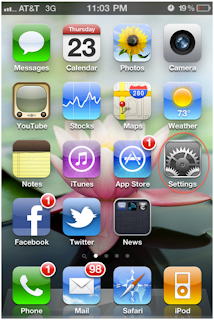
Step 2: Tap “General”
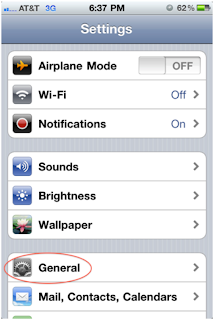
Step 3: Tap “Restrictions”
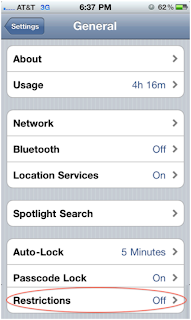
Step 4: Tap “Enable Restrictions”
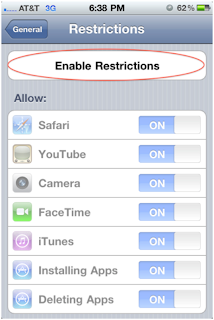
Step 5: Enter your passcode to prevent tampering with the parental controls. Note, that this may also be an alphanumeric passcode. If no passcode is set, you will be prompted to create one.
Step 6: Select applications and features to disable and select ratings appropriate for the user.
Step 1: Tap “Settings”

Step 2: Tap “General”

Step 3: Tap “Restrictions”

Step 4: Tap “Enable Restrictions”

Step 5: Enter your passcode to prevent tampering with the parental controls. Note, that this may also be an alphanumeric passcode. If no passcode is set, you will be prompted to create one.

Step 6: Select applications and features to disable and select ratings appropriate for the user.

Thursday, December 23, 2010
Internet Safety Tips - The Craigslist Killer Movie | myLifetime.com
Internet Safety Tips - The Craigslist Killer Movie | myLifetime.comIn partnership with Lifetime, WiredSafety and Parry have provided safety tips for its viewers in conjunction with the Craigslist Murders move, airing for the first time on January 3rd. Parry uses craigslist often to shop for and sell items, hire staff and look for rentals. But she and the other volunteers at WiredSafety have learned ways to limit the risks of real life encounters from the Internet. While the murders that occur, occur very rarely, even one is too often. And becoming a victim of a scam artists who takes your money and fails to deliver as promised online can be devastating, especially over the holidays and in this challenging economic times.
Bottom line - use your head and some of Parry's tips to get a good deal or find love, safely, online.
Bottom line - use your head and some of Parry's tips to get a good deal or find love, safely, online.
CNN.com - Transcripts
CNN.com - TranscriptsCNN International - Parry discusses online privacy and governmental regulations.
Tuesday, December 21, 2010
CBC News - Nfld. & Labrador - Facebook Amber Alert page now in N.L.
CBC News - Nfld. & Labrador - Facebook Amber Alert page now in N.L.Parry Aftab and her husband, Canadian child safety expert, help launch their fourth amber alert on Facebook page in Canada. It is the first time, anywhere in the world, that amber alert if officially hosted in facebook. The US is expected to follow in 2011.
Saturday, December 18, 2010
Online Dating - Apps and Laws Strive for Safer Matchmaking - NYTimes.com
Online Dating - Apps and Laws Strive for Safer Matchmaking - NYTimes.comFor fifteen years we have been advising lonely singles on ways to cyberdate more safely. Some sites offer background checks. Others do marital checks. Some guard your personal information from those you meet online until you are ready to share more. Bottom line - be careful, meet in a public place, take it slow and bring friends in the beginning (preferably sumo-wrestlers :-)). But during these days when we work 24/7...the Internet can be a big help in finding matches. Visit wiredsafety.org's cyberdating tips. And if something doesn't feel right, stop the communications and report it.
Sunday, December 12, 2010
Generation Mobile Tuesday December 14, 2010 « Wired Moms
Generation Mobile Tuesday December 14, 2010 « Wired MomsParry will be appearing as a panelist at the FCC's kids and mobile event
Wednesday, December 08, 2010
Tuesday, December 07, 2010
Friday, December 03, 2010
WiredSafety and Parry Aftab support the legalization and tough regulation of online gambling

WiredSafety.org and, Internet privacy and security expert,
Parry Aftab Support
Licensing and Regulation of Online Poker
Washington, DC (December 3, 2010) –Parry Aftab, Executive Director of WiredSafety.org, the world’s largest online safety and education group, today released the following statement in response to news reports regarding a new bill that would license and regulate online poker. Existence of the bill was first reported in today’s Wall Street Journal.
“As I informed Congress during my testimony last year, licensing and regulating online poker is the most effective and responsible way to ensure the online safety of America’s children and consumers. Given today’s news reports regarding a potential bill Congress is circulating which would implement this important step, I encourage lawmakers to consider the importance of this action in protecting America’s children and consumers.
In a study Wired Safety commissioned last year (available on the WiredSafety.org website), Harvard Professor, Dr. Malcolm Sparrow, evaluated the 10 biggest risks associated with online gambling and determined overwhelmingly that the most effective way to protect consumers – including our children, is to regulate and license rather than pretend to be able to ban online gambling. Nothing illustrates the failure of existing regulations better than the millions of Americans who play poker on the internet despite the passage of 2006’s Unlawful Internet Gambling Enforcement Act (UIGEA).
“At the time of my testimony, I recognized the irony of our study’s conclusion that the best way to protect consumers from the risks of online gambling is to legalize it, rather than attempt to ban it. But over the last fifteen years I have spent in child and consumer online protection, I have learned the hard way that some solutions are ironic. Attempts to try and outright ban online gambling have been ineffective and the problems continue to grow without recourse. It has become the “hear no evil, see no evil, speak no evil” problem. It’s time to speak out and do something to stop the online gambling abuses, crimes and fraud we have been witnessing,” explains Aftab.
It is hoped that this bill will give government the teeth it needs to address criminal gambling sites and unethical providers targeting our nation’s youth. It will enable governmental agencies to ensure legal players are protected and young people are excluded from licensed online gambling sites. According to Aftab, “Given the growing popularity of online poker, especially on college campuses, we cannot afford to miss this opportunity to protect America’s children and consumers. We must take action now.”
Subscribe to:
Posts (Atom)